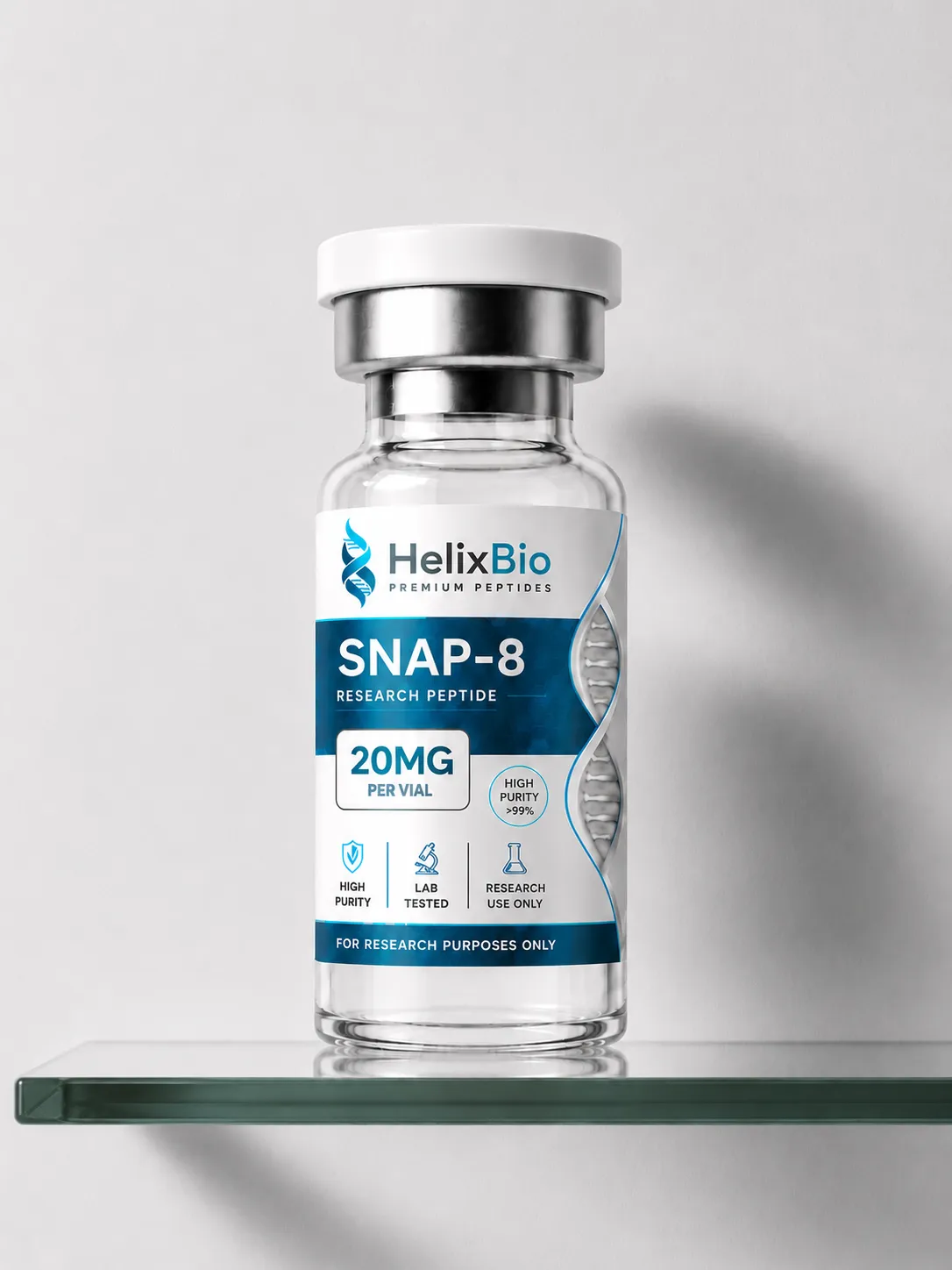
SNAP-8 is a trade name for acetyl octapeptide-3, a synthetic peptide with the sequence Ac-EEMQRRAD-NH2 and an average molecular weight of approximately 1,075 Da.
The sequence reproduces residues 12 to 19 of human SNAP-25, a 206-residue protein that contributes two of the four helices in the neuronal SNARE complex.
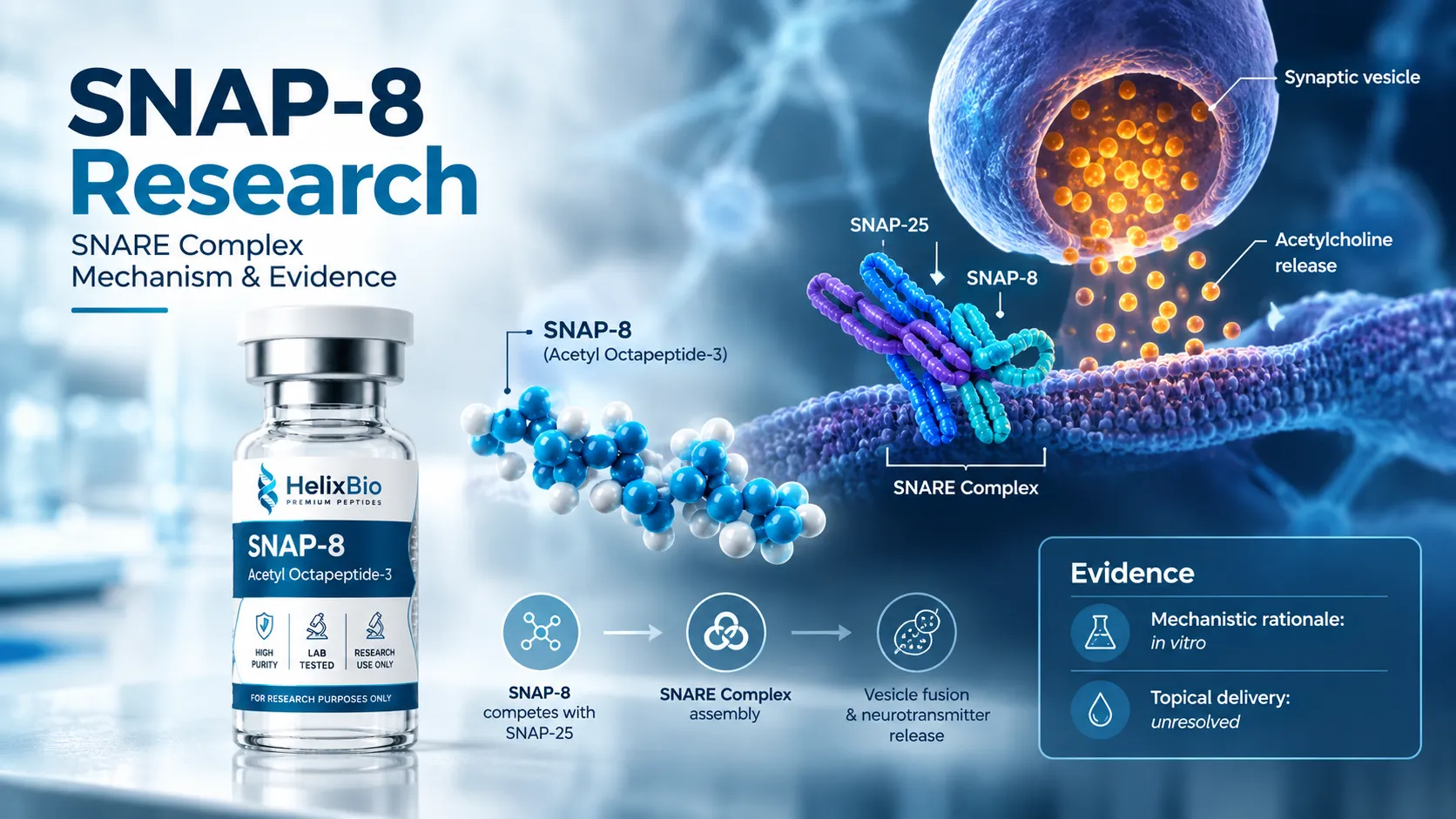
The proposed mechanism is competition with full-length SNAP-25 during SNARE assembly, which would lower vesicle fusion efficiency rather than abolish it.
Solution NMR work shows the region from Ala5 to Val36 of monomeric SNAP-25 is helical while the rest is disordered, and it has been proposed as the nucleation site for SNARE zippering.
Botulinum neurotoxin type A cleaves SNAP-25 enzymatically between Gln197 and Arg198, at the opposite end of the protein from the segment SNAP-8 reproduces.
Botulinum toxin acts catalytically while a competing peptide acts stoichiometrically, so the two mechanisms scale with dose in fundamentally different ways.
Argireline is acetyl hexapeptide-3, reproducing residues 12 to 17 of the same region; the two peptides differ by about 186 Da and separate in a single mass spectrometry run.
The founding SNARE-interference and neurotransmitter-release experiments were published for the hexapeptide in 2002, not for acetyl octapeptide-3.
The widely quoted 63.13 percent wrinkle-depth figure is a reported maximum from manufacturer-sponsored testing with no published sample size, control arm or statistical analysis.
Independent in vitro skin-penetration work found 0.22 percent of an applied 10 percent hexapeptide formulation in the stratum corneum and none in the receptor solution after 24 hours.
Acetyl octapeptide-3 appears in published human studies only within multi-ingredient products; no independent randomised trial of the peptide alone was identified.
EEMQRRAD contains no tryptophan or tyrosine, so absorbance at 280 nm cannot determine peptide content and detection must run near 214 nm or by mass spectrometry.
Most short cosmetic peptides are marketed with a mechanism vague enough to be unfalsifiable: they support, signal, or restore. SNAP-8 is unusual in the opposite direction. The claim made for it names a specific protein, a specific complex, and a specific step in that complex's assembly. That precision is what makes the peptide scientifically interesting, and it is also what makes the distance between the proposed mechanism and the supporting evidence measurable. This article separates the two — what the molecule is, what it is proposed to do at the SNARE complex, what has actually been shown and at which level of evidence, and where the commonly repeated claims outrun anything a published study establishes.
Featured In This Article
Snap-8
RESEARCH PEPTIDE
Highly purified synthetic peptide prepared for rigorous laboratory research.
$77.00
The short answer
SNAP-8 is a trade name for acetyl octapeptide-3, a synthetic eight-residue peptide whose sequence reproduces residues 12 to 19 of the neuronal protein SNAP-25. Its proposed mechanism is competition with full-length SNAP-25 during assembly of the SNARE complex, the four-helix protein bundle that drives synaptic vesicle fusion and therefore neurotransmitter release.
That mechanism is an extension of work done on a shorter relative. Argireline (acetyl hexapeptide-3, also listed as acetyl hexapeptide-8) reproduces residues 12 to 17 of the same region, and a 2002 paper in the International Journal of Cosmetic Science reported that it interfered with SNARE complex formation in a reconstituted cell-free system and inhibited neurotransmitter release from secretory cells. For acetyl octapeptide-3 specifically, the peer-reviewed record is thin, and what exists is largely analytical and formulation science rather than efficacy work. The wrinkle-depth percentages repeated across the internet trace to manufacturer-sponsored cosmetic testing that has not been published as an independent peer-reviewed trial. No independent randomised human study of acetyl octapeptide-3 on its own was identified.
What SNAP-8 Is: Acetyl Octapeptide-3 in Context
The molecule is a linear octapeptide with the sequence Ac-Glu-Glu-Met-Gln-Arg-Arg-Ala-Asp-NH2, written in single-letter code as Ac-EEMQRRAD-NH2. Both termini are capped: an acetyl group on the N-terminus and an amide on the C-terminus. Capping removes the charges a free peptide terminus would carry and blocks the exopeptidases that trim unprotected ends, which is standard practice for short synthetic peptides intended to survive in a formulation. The average molecular weight is approximately 1,075 Da.
Two naming points cause persistent confusion. SNAP-8 is a trademarked ingredient name; acetyl octapeptide-3 is the INCI designation that appears on ingredient lists. And SNAP-8 is not an abbreviation of SNAP-25 with a different number attached — the two are unrelated naming conventions that happen to collide. SNAP-25 is a 206-residue human protein named for synaptosomal-associated protein of 25 kDa. SNAP-8 is a commercial name for a peptide copied out of it.
SNAP-8 is a trademark held by its originating ingredient supplier. Research-grade acetyl octapeptide-3 supplied for laboratory use is the same chemical entity but is not the trademarked cosmetic trade solution, which is sold as a dilute aqueous preparation rather than as peptide powder.
Where the Eight Residues Come From
Human SNAP-25 begins MAEDADMRNELEEMQRRADQ. Counting from the initiator methionine, the segment EEMQRRAD occupies positions 12 through 19. Argireline's EEMQRR occupies positions 12 through 17 — the 2002 paper states that window explicitly. SNAP-8 is therefore the same starting point extended by two residues, alanine and aspartate, at the C-terminal end.
That extension is worth roughly half a turn of an alpha helix, and it is also the cleanest bench-level way to tell the two peptides apart. Alanine and aspartate together add about 186 Da, so acetyl octapeptide-3 at roughly 1,075 Da and Argireline at roughly 889 Da separate unambiguously in a single mass spectrometry run.
How the SNARE Complex Works, and Where SNAP-8 Is Proposed to Interfere
Regulated neurotransmitter release depends on a vesicle fusing with the presynaptic membrane, and that fusion is driven by three proteins. Syntaxin-1 sits in the plasma membrane. VAMP, also called synaptobrevin, sits in the vesicle membrane. SNAP-25 sits on the plasma membrane and is unusual in contributing two helical segments rather than one: SN1, spanning roughly residues 11 to 81, and SN2, spanning roughly residues 141 to 204.
Those four helices — one from syntaxin-1, one from VAMP, and two from SNAP-25 — wind into a parallel four-helix bundle. Assembly is directional. It nucleates at the membrane-distal N-terminal ends and zippers toward the membrane-anchored C-terminal ends, and it is that zippering that pulls the two membranes close enough to fuse. Calcium sensing by synaptotagmin-1 then triggers the final step, and acetylcholine is released into the synaptic cleft. At a neuromuscular junction, that acetylcholine is what tells the muscle fibre to contract.
The proposal for SNAP-8 is that a peptide reproducing part of SNAP-25's own sequence can occupy a position in the forming bundle, producing a complex that is assembled but destabilised, and so lowering the efficiency of vesicle fusion rather than abolishing it.
Why the N-Terminal Region Is the Interesting Target
The design rationale is more defensible than most cosmetic-peptide mechanisms, and the reason is structural. Solution NMR work on monomeric SNAP-25a found that the protein is largely disordered before it engages its partners — but not entirely. The region from Ala5 to Val36 retains helical structure, comprising two short helices, and the authors proposed that this pre-formed N-terminal helical region acts as the nucleation site that initiates SNARE zippering. Residues 12 to 19 sit inside it.
So the segment both SNAP-8 and Argireline copy is not an arbitrary slice of the protein. It is the part that is already folded when everything else is not, at the end where assembly starts. Argireline's original design came from scanning the SNAP-25 sequence for coiled-coil propensity and predicted helical content and selecting the window that scored on both, which is consistent with the same conclusion reached from the opposite direction.
Two qualifications follow immediately. A competitive occupant works stoichiometrically — it must be present in meaningful concentration at the site of assembly, unlike an enzyme, which works catalytically. And the experiments demonstrating interference were performed in purified reconstituted systems and in cultured secretory cells, at concentrations a topical route may never produce in tissue.
SNAP-8 and Botulinum Toxin: Same Protein, Opposite Ends
The comparison is made constantly and is almost always made wrongly. Both act on SNAP-25, which is where the similarity ends. Botulinum neurotoxin type A is a zinc-dependent protease whose light chain hydrolyses a single peptide bond in SNAP-25, between Gln197 and Arg198, removing nine residues from the C-terminus. Serotype E cuts at Arg180 to Ile181, removing twenty-six. Serotype C cleaves both SNAP-25 and syntaxin, while serotypes B, D, F and G cleave VAMP instead.
Those cleavage sites sit in SN2, at the membrane-proximal end of the protein. The segment SNAP-8 reproduces sits in SN1, at the opposite end. The two act on different regions of the same molecule through entirely different chemistry.
Property
SNAP-8 (acetyl octapeptide-3)
Botulinum neurotoxin type A
Class
Synthetic octapeptide, ~1,075 Da
Bacterial protein toxin, ~150 kDa
Region of SNAP-25 involved
N-terminal SN1 region, residues 12 to 19
C-terminal SN2 region, Gln197 to Arg198
Chemistry
Proposed non-covalent competition during assembly
Enzymatic cleavage of a peptide bond
Stoichiometry
One molecule occupies one site
Catalytic; one enzyme cleaves many substrates
Effect on the target protein
Target protein left intact
Target protein permanently truncated
Route in documented use
The practical consequence of the stoichiometry row is often missed. A catalytic enzyme delivered directly into the cytosol of a nerve terminal can inactivate a large substrate pool from a very small dose. A peptide competing for a binding position cannot amplify itself; whatever effect it has scales with how much of it arrives.
SNAP-8 and Argireline: Two Residues, and Two Very Different Files
The structural difference is small and well defined. The evidence difference is not.
Property
SNAP-8
Argireline
INCI name
Acetyl octapeptide-3
Acetyl hexapeptide-3 / acetyl hexapeptide-8
Sequence
Ac-EEMQRRAD-NH2
Ac-EEMQRR-NH2
SNAP-25 residues reproduced
12 to 19
12 to 17
Approximate molecular weight
1,075 Da
889 Da
Founding peer-reviewed mechanism paper
None identified for the octapeptide alone
Blanes-Mira and colleagues, 2002
Independent skin-penetration studies
None identified
Several, with conflicting results
The claim that the octapeptide is roughly 30 percent more active than the hexapeptide circulates widely. It originates in supplier technical literature. No independent head-to-head comparison of the two peptides was located, and there is no published structural work showing what the two added residues do to the peptide's contacts within the SNARE bundle. The mechanistic story for SNAP-8 is inherited from Argireline rather than independently established for it.
What SNAP-8 Research Actually Consists Of
Laying the evidence out by tier makes the shape of the problem obvious.
Evidence tier
What exists for acetyl octapeptide-3
Cell-free and biochemical
No published SNARE-assembly assay identified for the octapeptide. The reconstituted-complex work belongs to the hexapeptide.
Cell-based
No published neurotransmitter-release assay identified for the octapeptide specifically.
Analytical and formulation science
Real and peer-reviewed. An LC-MS/MS method for acetyl octapeptide-3 was published in 2020, and polymer nanoparticle carriers for it were characterised in 2023.
Manufacturer-sponsored in vivo cosmetic testing
The source of the widely quoted wrinkle-depth figures. Protocol, sample size and statistics are not publicly available.
Independent human research
Acetyl octapeptide-3 appears in published human studies only as one component of multi-ingredient products. No trial of the peptide alone was identified.
Regulatory status
A cosmetic ingredient by INCI listing. Not an approved drug in any jurisdiction identified.
The closest thing to human data naming this peptide is a 2020 monocentric study of hyaluronic acid microneedle patches over twelve weeks, which reported a 25.8 percent decrease in fine lines and wrinkles. The patches contained acetyl octapeptide-3 alongside four other actives, and the authors themselves describe the formulation as multi-targeted. A result from a five-ingredient product cannot be assigned to one ingredient.
The 63.13 Percent Figure, Read Carefully
One number dominates every page written about this peptide: a reported reduction in wrinkle depth of up to 63.13 percent after 28 days, usually paired with 27.05 percent for Argireline under stated-comparable conditions. Anyone citing it should notice several things.
It is a maximum, not a mean. The phrase used is consistently "up to," which describes the best-responding measurement rather than the average result. Two decimal places on an "up to" figure imply a precision that the qualifier itself denies. The comparator condition is described only loosely — public restatements refer to a 10 percent solution without consistently stating whether that means 10 percent peptide or 10 percent of a trade solution that is itself dilute, and those are not the same experiment. No sample size, no control arm, no statistical test and no measurement instrument are reported in the sources that repeat it. And it has not appeared in a peer-reviewed journal.
None of that makes the figure false. It makes it unverifiable, which is a different and more important problem for anyone trying to design an experiment around it.
Evidence-level language matters when writing about this compound. Manufacturer cosmetic testing is not a clinical trial, a maximum is not a mean, and a percentage without a denominator, a control and a statistical test is a marketing figure rather than a research finding.
The Delivery Step the Whole Mechanism Depends On
Every version of the SNAP-8 mechanism requires the peptide to reach nerve terminals innervating facial muscle. That is the step with the most published data, and the data conflict.
The 2002 Argireline paper reported an in vitro permeation experiment in which about 30 percent of an applied 10 percent oil-in-water emulsion reached the receptor fluid within two hours. A 2015 study from a United States Food and Drug Administration laboratory ran a comparable experiment for 24 hours and found that 0.22 percent of the applied peptide entered the stratum corneum, that 99.7 percent was recovered by washing the surface, and that none was detectable in the receptor solution at all. Tape stripping in that work and in a separate 2015 emulsion study showed peptide concentrated in the outermost stratum corneum and declining toward the viable epidermis.
Vehicle changes the result. Multiple water-in-oil-in-water emulsions outperformed simple oil-in-water systems, and the peptide was undetectable from a water-in-oil emulsion. Microneedle pretreatment increased cumulative permeation of the hexapeptide by more than thirty-fold over passive flux, which is a delivery result rather than an efficacy result — the same distinction that governs any claim about a molecule reaching a protected tissue compartment.
Two further points bound the argument. Reaching the viable epidermis is not the same as reaching a neuromuscular junction; the muscles of facial expression and their motor endplates sit well below the dermis. And a 2025 review of the hexapeptide's permeability literature concluded that none of the published in vivo application studies demonstrated inhibition of muscle contraction at all, and that transdermal delivery sufficient to produce a paralysing effect in muscle is likely unachievable. The measured skin changes may well be real; the mechanism attributed to them is the part that has not been demonstrated.
An Alternative Target Has Been Proposed
The competitive-SNARE story is not the only mechanistic hypothesis in the peer-reviewed literature. A 2018 molecular modelling study examined this class of so-called botox-like peptides against synaptotagmin-1, the calcium sensor that triggers the final fusion step, and reported that the modelled peptides bound in a cleft at the C2A–C2B domain interface and rigidified the protein, suppressing the conformational change from its closed to its open form. That work is computational, it treats the peptides as a class, and its abstract does not itemise which sequences were modelled — so it should not be read as a finding about acetyl octapeptide-3 in particular. It should be read as evidence that even within the specialist literature, the target of these peptides is treated as an open question rather than a settled one.
What We Still Do Not Know
Whether acetyl octapeptide-3 interferes with SNARE assembly in a reconstituted system at all. The assay has been published for the hexapeptide, not the octapeptide.
What the two additional residues change. No structural or binding study comparing the two peptides at the SNARE interface was identified.
Whether enough peptide reaches a motor nerve terminal in intact human skin to matter, and at what concentration interference would begin.
Whether the measured cosmetic endpoints arise from the neuromuscular mechanism at all, or from formulation and epidermal effects that would occur with an inactive peptide of similar physical properties.
What the effect size is under blinded, controlled conditions, since no such trial of the peptide alone has been published.
This is the same pattern seen with other short peptides cut out of larger parent proteins, where the fragment's identity is well characterised and its biology is inferred from the parent — the KPV tripeptide's relationship to alpha-MSH follows a comparable logic, with a comparably careful reading required.
Research-Use Context and Analytical Notes
Acetyl octapeptide-3 supplied as research-grade SNAP-8 is a laboratory material, not a cosmetic product and not a drug. It has no approved therapeutic indication and no established human use, and material sold under research-use-only terms is not evaluated for safety or efficacy in humans.
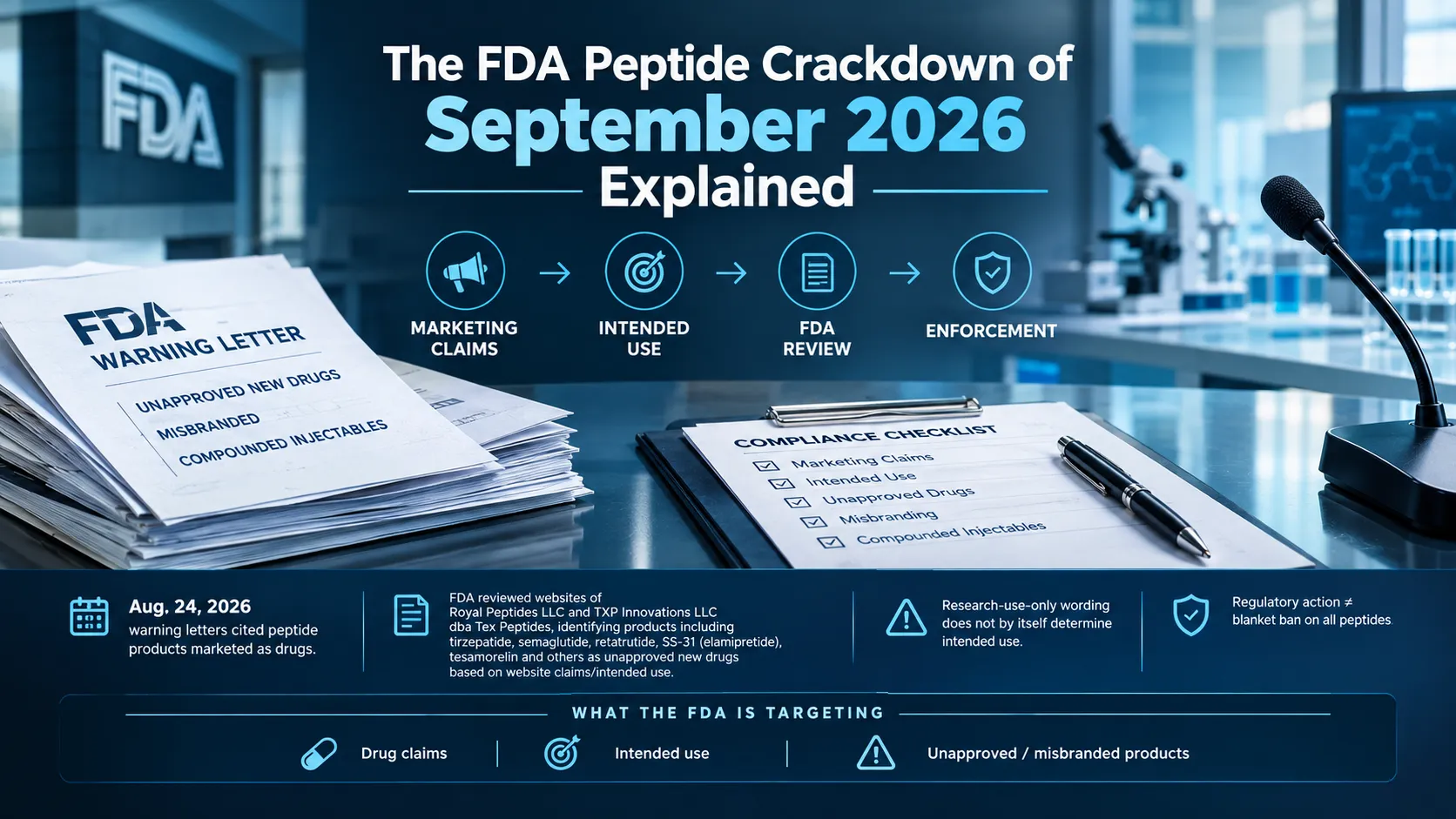
There is a regulatory point buried in the marketing that is worth stating plainly. Under the United States Federal Food, Drug, and Cosmetic Act, a cosmetic is defined by its intended effect on appearance, while an article intended to affect the structure or any function of the body is a drug. A product claiming to relax facial muscles is claiming a structure-or-function effect. The stronger the neuromuscular claim made for a topical peptide, the more it argues itself out of the cosmetic category — which is one reason careful ingredient literature stays with appearance endpoints.
Two analytical points specific to this sequence. EEMQRRAD contains no tryptophan and no tyrosine, so absorbance at 280 nm cannot be used to determine peptide content; UV detection has to run near 214 nm, or quantitation has to be done by mass spectrometry. And the single methionine is an oxidation liability that shows as a plus-16 Da species, while loss of the C-terminal amide shows as roughly plus-1 Da. Both are worth looking for when [reading the certificate of analysis](/how-to-read-peptide-certificate-of-analysis) for a lot.
Identity and quantitation are, unusually, the best-solved part of this compound's file. A published LC-MS/MS method reports a limit of quantification of 0.0125 ng/mL for acetyl octapeptide-3 and was applied to a biodegradable microneedle patch. It is a useful reminder of where the peer-reviewed effort has actually gone: into measuring the peptide accurately, not into establishing what it does.
For laboratories working on cosmetic peptide chemistry more broadly, the contrast with a compound like GHK-Cu is instructive. Different mechanism, different evidence profile, and a different set of verification problems — but the same discipline applies. Find the primary source, check what tier of evidence it sits at, and check whether the claim in front of you was ever made about the exact molecule named on the vial.
Got Questions?
Frequently Asked Questions
SNAP-8 is a trade name for acetyl octapeptide-3, a synthetic eight-residue peptide with the sequence Ac-EEMQRRAD-NH2. Its sequence reproduces residues 12 to 19 of the neuronal protein SNAP-25, and it is studied in cosmetic peptide research and in SNARE-complex model systems.
The proposed mechanism is competitive interference with SNARE-complex assembly: the peptide is thought to occupy a position that full-length SNAP-25 would otherwise fill, producing a destabilised complex and reducing vesicle fusion efficiency. This is a hypothesis extended from published work on the shorter hexapeptide Argireline rather than a mechanism demonstrated for the octapeptide itself.
The SNARE complex is a parallel four-helix bundle formed by syntaxin-1, VAMP or synaptobrevin, and two helical segments contributed by SNAP-25. Assembly nucleates at the N-terminal ends and zippers toward the membrane anchors. SNAP-8 reproduces a segment inside SNAP-25's first SNARE motif, at the end where assembly begins.
No. Argireline is acetyl hexapeptide-3, sequence Ac-EEMQRR-NH2, reproducing residues 12 to 17 of SNAP-25. SNAP-8 extends the same starting point by alanine and aspartate to residue 19. The two differ by roughly 186 Da and are not interchangeable in an experiment.
Not mechanistically. Botulinum neurotoxin type A is a protease that cleaves SNAP-25 between Gln197 and Arg198 and permanently truncates the protein. SNAP-8 is proposed to compete non-covalently at the opposite end of the same protein, leaving it intact. The toxin also acts catalytically while a competing peptide acts stoichiometrically.
The sequence is Ac-Glu-Glu-Met-Gln-Arg-Arg-Ala-Asp-NH2, written Ac-EEMQRRAD-NH2, with an acetylated N-terminus and an amidated C-terminus. The average molecular weight is approximately 1,075 Da. Lot-specific values should always be confirmed against the applicable certificate of analysis.
No independent randomised controlled trial of acetyl octapeptide-3 on its own was identified. The percentages quoted across ingredient and vendor literature originate in manufacturer-sponsored cosmetic testing that has not been published in a peer-reviewed journal with a protocol, sample size or statistical analysis attached.
It has appeared in published human studies only as one component of multi-ingredient products, such as a 2020 twelve-week monocentric study of hyaluronic acid microneedle patches containing five actives. A result from a multi-ingredient formulation cannot be attributed to any single ingredient.
It is described in every source that repeats it as a maximum reduction rather than a group mean, from manufacturer-sponsored testing over 28 days. No sample size, control arm, statistical test or measurement instrument is reported, and the figure has not appeared in a peer-reviewed journal, so it cannot be independently verified.
That step is unresolved and is where the published evidence conflicts most sharply. Independent in vitro work on the related hexapeptide found 0.22 percent of an applied dose in the stratum corneum and none in the receptor solution after 24 hours, and a 2025 review of that literature concluded that delivery sufficient to inhibit muscle contraction is likely unachievable topically.
No. Acetyl octapeptide-3 is listed as a cosmetic ingredient under its INCI name and has no approved therapeutic indication. Research-grade material is supplied for laboratory use only and is not evaluated by any regulator for safety or efficacy in humans.
Lot number, HPLC purity with the detection wavelength stated, and mass-spectrometry identity confirmation against the expected mass. Because the sequence contains no tryptophan or tyrosine, quantitation cannot rely on absorbance at 280 nm. Researchers should also look for a plus-16 Da methionine oxidation species and a roughly plus-1 Da signal indicating loss of the C-terminal amide.