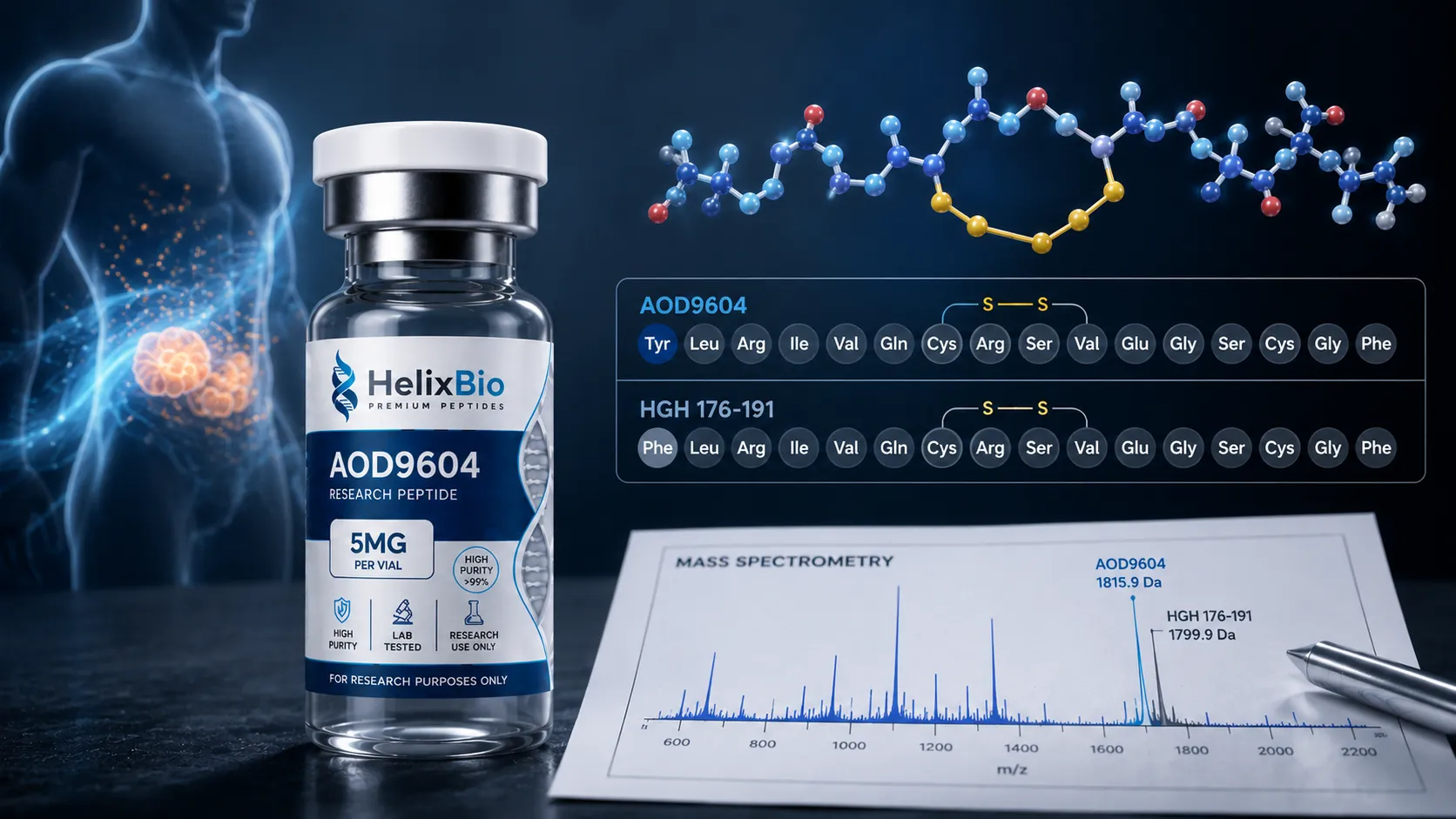
- AOD9604 is a 16-amino-acid peptide with the sequence Tyr-Leu-Arg-Ile-Val-Gln-Cys-Arg-Ser-Val-Glu-Gly-Ser-Cys-Gly-Phe, filed as SEQ ID NO: 1 in Metabolic Pharmaceuticals patent applications.
- AOD9604 and HGH Fragment 176-191 differ at a single position, where tyrosine replaces the native phenylalanine at the N-terminus, a difference of one hydroxyl group and roughly 16 Da.
- HGH Fragment 176-191 has not been studied in humans, and the lipolytic claims commonly attached to it are extrapolated from clinical data generated with AOD9604.
- Effective doses of AOD9604 in clinical trials did not raise plasma IGF-1, and ligand-binding work indicated it is not a high-affinity antagonist of human growth hormone at the GH receptor.
- AOD9604's effects on lipid metabolism in mice required an intact beta-3 adrenergic receptor pathway and were absent in beta-3-AR knockout animals.
- In METAOD005, a 12-week Phase IIb trial of 300 obese adults across five Australian hospitals, the 1 mg daily oral group lost approximately 2.8 kg against approximately 0.8 kg for placebo.
- The larger follow-up trial METAOD006, known as OPTIONS, recruited 536 subjects and did not reach statistical significance at either the 12-week or 24-week endpoint, and Metabolic Pharmaceuticals halted formal drug development in 2007.
- AOD9604's GRAS status was a conditional self-affirmed determination made in 2012 by an expert panel convened by the company, not an FDA review, an FDA response letter, or a drug approval.
AOD9604 is a 16-amino-acid peptide corresponding to the C-terminal region of human growth hormone, and the question that dominates AOD9604 peptide research is whether it is the same thing as HGH Fragment 176-191. It is not. The two molecules differ by a single residue at the N-terminus, and that one substitution separates a compound with six completed human clinical trials from a compound that has never been studied in humans at all. That distinction is routinely collapsed in product listings and in secondary content, which then attributes AOD9604's trial data to the unmodified fragment. This piece covers the structural difference precisely, the mechanism as the primary literature describes it, the full clinical trial record including the trial that failed, what a compliant certificate of analysis should show, and why the widely repeated claim that AOD9604 "received FDA GRAS status" is wrong in a specific and consequential way.
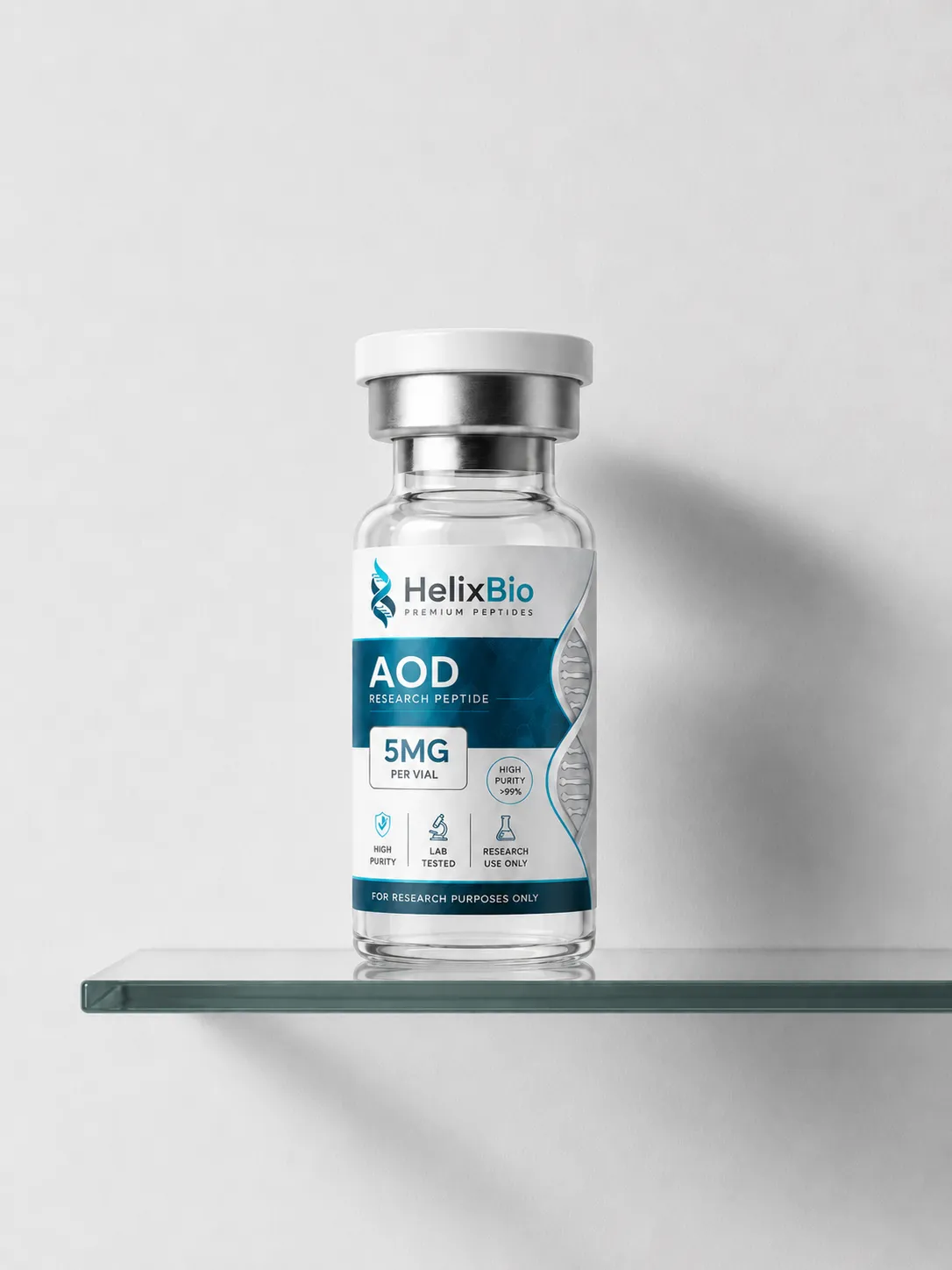
AOD9604
RESEARCH PEPTIDE
AOD9604 is a synthetic research peptide derived from the C-terminal fragment of human growth hormone (hGH 176-191), modified with an additional stabilizing tyrosine residue. It's studied in preclinical and early clinical research for its role in lipolysis — fat breakdown — without engaging the growth-promoting or IGF-1-elevating effects associated with full-length hGH. Originally developed by the Australian biotech Metabolic Pharmaceuticals Ltd, AOD9604 progressed through six Phase I/II human trials before its pivotal efficacy trial fell short, ending formal drug development in 2007. It remains a compound of interest in metabolic and adipocyte research today. Helix Bio supplies AOD9604 as a lyophilized powder intended strictly for laboratory research, manufactured to a high-purity standard and backed by third-party verification. It is not intended for human consumption, diagnostic use, or any therapeutic application.
What Is AOD9604? The Monash and Metabolic Pharmaceuticals Program
The compound originated at Monash University in Melbourne, in a program directed by Professor Frank Ng. The starting observation was that human growth hormone has functionally separable domains. The region spanning residues 108-129 evokes strong mitogenic responses, while the carboxy-terminal region around residues 177-191 acts as a lipid-mobilizing domain, reported to inhibit acetyl-CoA carboxylase activity in adipocytes and hepatocytes.
The program's objective was to isolate the lipid-metabolism signaling of growth hormone from the growth-promoting and glucose-affecting activity mediated through the GH receptor and IGF-1. The resulting compound was designated AOD9604, where AOD stands for Anti-Obesity Drug and refers to the internal development program rather than to any marketed product. Metabolic Pharmaceuticals Limited, later a subsidiary of Calzada Limited, took it into clinical development.
The compound is prepared by solid-phase peptide synthesis. Structural work reported that its secondary structure resembles the homologous region within the intact hGH molecule, which is the basis for the claim that it recapitulates rather than merely mimics the parent domain.
AOD9604 Versus HGH Fragment 176-191: The Structural Distinction
The published sequence of AOD9604, filed in Metabolic Pharmaceuticals' patent applications as SEQ ID NO: 1, is Tyr-Leu-Arg-Ile-Val-Gln-Cys-Arg-Ser-Val-Glu-Gly-Ser-Cys-Gly-Phe. The unmodified fragment is Phe-Leu-Arg-Ile-Val-Gln-Cys-Arg-Ser-Val-Glu-Gly-Ser-Cys-Gly-Phe.
Everything after position one is identical, including the cysteine pair that forms the intramolecular disulfide bridge. The difference is at the N-terminus, where the native phenylalanine at residue 176 is replaced by tyrosine. Chemically, that is the addition of a single hydroxyl group to the aromatic ring of the first residue. The literature describes AOD9604 as residues 177-191 with an added N-terminal tyrosine, which produces the same 16-residue length by a different route of description. Both descriptions appear in the primary sources and both refer to the same molecule.
Property | AOD9604 | HGH Fragment 176-191 |
|---|---|---|
N-terminal residue | Tyrosine | Phenylalanine |
Sequence description | Tyr-hGH177-191 | hGH176-191, native sequence |
Length | 16 residues | 16 residues |
Disulfide bridge | Cys-Cys, present | Cys-Cys, present |
Molecular weight | Approximately 1,815 Da | 1,799.10 g/mol |
Molecular formula | Differs from the fragment by one oxygen | C78H123N23O22S2 |
CAS number | Assigned separately | 66004-57-7 |
Stated purpose of modification | Stabilization of the short fragment during synthesis and storage | Not applicable; unmodified native sequence |
Human clinical trials | Six completed randomized, double-blind, placebo-controlled trials | None |
Basis for lipolytic claims | Direct trial and preclinical data | Extrapolated from AOD9604 data |
That last row is the one that matters. HGH Fragment 176-191 has been presented as a lipolytic peptide largely on the strength of clinical data generated with AOD9604, which is a different molecule. Whatever a researcher concludes about one, it does not transfer to the other without independent evidence.
The Phe-to-Tyr substitution creates a 16 Da mass difference between AOD9604 and HGH Fragment 176-191. Any functioning mass spectrometer resolves that difference trivially. This means a mass spec identity trace on a certificate of analysis is not a formality for these two compounds; it is the single measurement that distinguishes them. If a supplier lists both products and the COAs report identical observed masses, one of the two documents is wrong.
Mechanism: Lipolytic Signaling Without the IGF-1 Axis
Clinical trial work on AOD9604 showed that effective doses did not raise plasma IGF-1. That result was the point of the program, and it separates AOD9604's effect on lipid metabolism from the IGF-1-mediated pathway through which most of growth hormone's anabolic and glucose-affecting actions run.
Intact hGH signals by binding one receptor molecule, then recruiting a second to form a trimeric complex of one hormone and two receptors. Only when that trimer forms does downstream signal transduction initiate. AOD9604 comprises just the C-terminal segment and does not reproduce that binding geometry. Ligand-binding experiments indicated that AOD9604 is not a high-affinity antagonist of hGH binding at the GH receptor, so it neither activates nor blocks the classical pathway.
The clearest positive mechanistic finding comes from Heffernan and colleagues, published in Endocrinology in 2001. Working in obese mice and in beta-3 adrenergic receptor knockout mice, the group found that AOD9604's effects on lipid metabolism required an intact beta-3 adrenergic receptor pathway. The effect was present in wild-type animals and absent in the knockouts. Related work in obese mice reported increased expression of beta-3 adrenoreceptor RNA, which had been repressed in those animals.
The honest summary is that the mechanism is partially characterized. The negative findings are solid: no IGF-1 increase, no high-affinity GH receptor antagonism, no growth-promoting or pro-diabetic effect in the animal models tested. In contrast to hGH, AOD9604 showed no apparent effect on glycemia, insulin secretion, or insulin sensitivity in ob/ob mice, where hGH significantly raised plasma glucose and reduced glucose oxidation. The positive mechanism, dependence on beta-3 adrenergic signaling, is documented but does not amount to an identified receptor for the peptide itself. Review literature from the program's own investigators states plainly that the mechanism of action of AOD9604 is not understood.
The Clinical Trial Record, Including the Trial That Failed
Six randomized, double-blind, placebo-controlled human trials were conducted with AOD9604, summarized in a 2013 safety paper by Stier, Vos and Kenley in the Journal of Endocrinology and Metabolism. The trials were designated METAOD001 through METAOD006 and progressed from intravenous single doses in healthy volunteers to long-term oral dosing in obese adults.
Trial | Design | Population | Dosing |
|---|---|---|---|
METAOD001 | Phase I, double-blind, placebo-controlled, dose escalation | 15 healthy adult males, BMI 24-30 | 25 to 400 µg/kg intravenous, with recombinant hGH as positive control |
METAOD003 | Phase IIa, double-blind, placebo-controlled, 4x4 Latin square | 17 clinically obese males, BMI 35+ | Single oral doses of 9, 27, 54 mg |
METAOD004 | Phase IIa, double-blind, placebo-controlled, dose escalation | 36 clinically obese males, BMI 30+ | 9, 27 or 54 mg orally daily for 7 days |
METAOD005 | Phase IIb, randomized, double-blind, placebo-controlled | 300 obese adults, BMI 35+, median BMI 40, 54% male | 1, 5, 10, 20 or 30 mg orally daily for 12 weeks, n = 50 per group, five Australian hospitals |
METAOD006 (OPTIONS) | Phase IIb, randomized, double-blind, placebo-controlled | 536 subjects recruited | 0.25, 0.5 or 1 mg orally daily, 24 weeks treatment, primary endpoint weight loss at 12 weeks |
METAOD005 is the trial cited in almost all AOD9604 content. The design included a two-week single-blind placebo run-in followed by 12 weeks of active dosing. The 1 mg group lost the most weight, reported at approximately 2.8 kg over 12 weeks against approximately 0.8 kg in the placebo group. Notably, the lowest dose tested outperformed the higher ones.
Two things about this result need stating explicitly, because they are usually omitted.
First, on publication status. The efficacy result was announced by the sponsor and presented at a scientific meeting rather than published as a standalone peer-reviewed efficacy paper. The trial's design and its safety findings were later described in the peer-reviewed Stier 2013 paper, which is a real publication and a legitimate source for those elements. A conference presentation and a sponsor announcement are not equivalent to a peer-reviewed efficacy publication, and a citation to one should not be presented as the other.
Second, and more importantly, METAOD005 was not the end of the story. The larger follow-up trial, METAOD006 or OPTIONS, recruited 536 subjects and tested lower doses over a longer period. It did not replicate the result. The FDA, in its own briefing document reviewing AOD9604, quotes the company's statement that weight loss compared to placebo at the primary and secondary endpoints of 12 or 24 weeks was too low to reach statistical significance. Metabolic Pharmaceuticals halted formal drug development in 2007. Review literature from the program's investigators attributes the divergence in part to the later trial incorporating an intensive diet and exercise regime, which the earlier one did not.
A research summary of AOD9604 that cites the 2.8 kg figure without the OPTIONS outcome is presenting the positive half of a two-trial record.
Certificate of Analysis and Purity Verification for AOD9604
AOD9604 has a specific analytical feature that most research peptides lack: an intramolecular disulfide bridge between the two cysteine residues. That single structural detail generates most of what should be checked on a COA.
Disulfide state. The oxidized, cyclized form and the reduced, free-thiol form differ by 2 Da. That is a small difference but well within the resolution of standard ESI-MS, and the two forms are distinguishable. A COA that reports a mass without specifying which form was observed leaves open whether the material is correctly folded. Reduced material and disulfide-scrambled dimers are both real outcomes of imperfect oxidation or of degradation in storage, and dimers appear at roughly double the monomer mass.
Identity against the correct sequence. As described above, the observed mass should reflect the tyrosine-containing sequence, near 1,815 Da, and not the phenylalanine-containing fragment at 1,799.1. The COA should print theoretical and observed values side by side.
Purity by RP-HPLC. Research-grade material is typically reported at 98% or higher by area normalization at 214 nm. Request the chromatogram, not a summary figure. For a disulfide-containing peptide, the reduced form and any dimer will resolve as distinct peaks, and their presence and size is the information a bare percentage discards.
Net peptide content. Lyophilized peptide ships as a salt with residual water. Acetate or trifluoroacetate counterion plus moisture commonly accounts for 10% to 20% of vial mass, so gross weight overstates peptide quantity by an amount that varies batch to batch.
Batch traceability. Match the COA lot number against the vial label, confirm the analysis date follows the synthesis date, and confirm the stated fill quantity. A single COA reused across every batch of a product tells you nothing about the vial you received.
The general framework for reading these documents is set out in the peptide certificate of analysis guide. Handling considerations for AOD9604 follow standard practice for disulfide-containing lyophilized peptides, with the added point that reducing conditions and heat both threaten the bridge. The reconstitution and stability reference covers post-reconstitution windows.
Regulatory Status: GRAS Is Not FDA Approval
The most frequently repeated regulatory claim about this compound is materially inaccurate, and correcting it is straightforward.
In June 2012, Metabolic Pharmaceuticals announced that AOD9604 had received a conditional self-affirmed GRAS determination. Three words in that sentence carry the weight. Self-affirmed means the determination was made by an expert panel that the company convened, not by the FDA. Conditional means the status was contingent on the company subsequently publishing its existing safety data in a peer-reviewed journal. And GRAS is a food-ingredient category, not a drug category. The determination covered use in foods and drinks, and eventually dietary supplements, at total per capita consumption of up to 1 mg per day.
The FDA operates a voluntary GRAS notification program, and substances that go through it receive a response letter from the agency. Self-affirmed GRAS determinations bypass that program entirely. Public interest databases that track ingredients added to foods without federal safety review specifically categorize self-affirmed GRAS substances as chemicals claimed to be GRAS which have not been reviewed by FDA for safety. AOD9604 is not FDA-approved as a drug, and its GRAS status is not an FDA finding.
The compounding record is separate and also worth stating accurately. On September 29, 2023, FDA placed AOD-9604 in Category 2 of its interim 503A bulks list, the category reserved for substances the agency identified as presenting significant safety risks. On September 27, 2024, AOD-9604 was removed from Category 2, alongside CJC-1295, ipamorelin acetate, thymosin alpha-1 and Selank acetate. The removal followed the nominators' withdrawal of the nominations, not an agency determination that the safety concerns had been resolved. FDA states on its own guidance page that a substance it has identified as presenting a potential significant safety risk might not appear in Category 2 because, for example, its nomination was withdrawn.
AOD9604 was not among the seven peptides reviewed at the July 2026 Pharmacy Compounding Advisory Committee meeting. The context of that proceeding is covered in the 2026 FDA 503A bulks list explainer, and the general research-use-only framework in the RUO compliance overview.
The Open Question in AOD9604 Research
The most interesting unresolved problem in this compound's record is the dose-response curve. In METAOD005, the 1 mg group outperformed the 5, 10, 20 and 30 mg groups. In METAOD006, doses of 1 mg and below produced no significant separation from placebo. A compound that works best at its lowest tested dose and then fails when the trial design isolates that dose is either showing a genuine non-monotonic response, or showing noise in a modestly sized trial that a larger one did not reproduce.
The beta-3 adrenergic dependence identified by Heffernan offers a testable frame for the first possibility, since receptor-mediated effects with downstream desensitization can produce exactly this shape. Nobody has run the experiment that would settle it, and Metabolic Pharmaceuticals stopped development nearly twenty years ago. What is left is a compound whose negative pharmacology, no IGF-1 increase, no GH receptor antagonism, no glycemic effect in animal models, is better established than its positive pharmacology, and whose most-cited human result was contradicted by the larger trial that followed it. Researchers comparing AOD9604 against other metabolic research compounds, such as those covered in the GLP-1 and GIP agonist research overview, should weight that trial history accordingly.
Frequently Asked Questions
AOD9604 is a synthetic 16-amino-acid peptide corresponding to the C-terminal lipolytic domain of human growth hormone, developed at Monash University and taken into clinical development by Metabolic Pharmaceuticals. The designation stands for Anti-Obesity Drug 9604 and refers to the development program rather than a marketed product.
No. The two sequences are identical from position two onward, including the cysteine pair that forms the disulfide bridge, but AOD9604 carries tyrosine at the N-terminus where the native fragment carries phenylalanine. Only AOD9604 has been studied in human clinical trials.
The published sequence is Tyr-Leu-Arg-Ile-Val-Gln-Cys-Arg-Ser-Val-Glu-Gly-Ser-Cys-Gly-Phe, described in the literature as Tyr-hGH177-191. It is filed as SEQ ID NO: 1 in Metabolic Pharmaceuticals patent applications.
AOD9604 has a molecular weight of approximately 1,815 Da. The unmodified HGH Fragment 176-191 is 1,799.10 g/mol, and the roughly 16 Da difference reflects the single added oxygen from the phenylalanine-to-tyrosine substitution.
The mechanism is only partially characterized, and review literature from the program's own investigators states that it is not fully understood. The clearest positive finding is that AOD9604's effects on lipid metabolism in mice required an intact beta-3 adrenergic receptor pathway, and disappeared in beta-3-AR knockout animals.
Clinical trial work reported that effective doses of AOD9604 did not raise plasma IGF-1, which was the central objective of the development program. Ligand-binding experiments also indicated that AOD9604 is not a high-affinity antagonist of human growth hormone binding at the GH receptor.
Six randomized, double-blind, placebo-controlled trials were conducted, designated METAOD001 through METAOD006. The most-cited result came from METAOD005, in which the 1 mg daily oral group of 300 obese adults lost approximately 2.8 kg over 12 weeks against approximately 0.8 kg for placebo.
The efficacy result from METAOD005 was announced by the sponsor and presented at a scientific meeting rather than published as a standalone peer-reviewed efficacy paper. The trial's design and safety findings were later described in a peer-reviewed 2013 paper by Stier, Vos and Kenley in the Journal of Endocrinology and Metabolism, which is a legitimate source for those elements but not for the efficacy claim.
No. The larger follow-up trial METAOD006, known as OPTIONS, recruited 536 subjects and did not reach statistical significance at either the 12-week or 24-week endpoint. Metabolic Pharmaceuticals halted formal drug development in 2007.
No. AOD9604 is not approved by the FDA as a drug for any indication, and no marketing application was filed. Material sold in the United States is supplied as a research-use-only compound.
In June 2012 the sponsor announced a conditional self-affirmed GRAS determination for AOD9604, made by an expert panel the company convened, covering use in foods and drinks at up to 1 mg per person per day and conditional on subsequent publication of existing safety data. Self-affirmed determinations bypass the FDA's voluntary GRAS notification program entirely, so this is not an FDA finding and is not comparable to drug approval.
It should report RP-HPLC purity with the chromatogram attached, mass spectrometry identity with theoretical and observed masses printed together, the disulfide state of the material, and net peptide content as a separate figure from gross vial weight. The lot number must match the vial label and the analysis date must follow the synthesis date.
Yes, and easily. The phenylalanine-to-tyrosine substitution produces a mass difference of roughly 16 Da, which any functioning mass spectrometer resolves. If a supplier lists both compounds and their certificates report identical observed masses, one of the two documents is incorrect.
AOD9604 contains two cysteine residues forming an intramolecular disulfide bridge, and the oxidized cyclized form differs from the reduced free-thiol form by 2 Da. That difference is within the resolution of standard ESI-MS, so a certificate reporting a mass without specifying the form leaves the question of correct folding unanswered. Disulfide-scrambled dimers appear at roughly double the monomer mass.
AOD-9604 was placed in Category 2 of the interim 503A bulks list on September 29, 2023, the category for substances FDA identified as presenting significant safety risks, and was removed on September 27, 2024 after the nominators withdrew the nominations. FDA notes that a substance may leave Category 2 because its nomination was withdrawn rather than because the identified risk was resolved, and AOD-9604 was not among the seven peptides reviewed in July 2026.
- 01Stier H, Vos E, Kenley D. Safety and tolerability of the hexadecapeptide AOD9604 in humans. J Endocrinol Metab. 2013;3(1-2):7-15.
- 02More, et al. Safety and metabolism of AOD9604, a novel nutraceutical ingredient for improved metabolic health. J Endocrinol Metab. 2014;4(3):64-77.
- 03Heffernan M, Summers RJ, Thorburn A, Ogru E, Gianello R, Jiang WJ, Ng FM. The effects of human GH and its lipolytic fragment (AOD9604) on lipid metabolism following chronic treatment in obese mice and beta(3)-AR knock-out mice. Endocrinology. 2001. PMID: 11713213
- 04Ng FM, Sun J, Sharma L, et al. Metabolic studies of a synthetic lipolytic domain (AOD9604) of human growth hormone. Horm Res. 2000.
- 05U.S. Food and Drug Administration. FDA Briefing Document, Pharmacy Compounding Advisory Committee Meeting: AOD-9604 review.
- 06U.S. Food and Drug Administration. Certain Bulk Drug Substances for Use in Compounding that May Present Significant Safety Risks.
- 07Calzada Limited (parent of Metabolic Pharmaceuticals Pty Ltd). ASX announcement: conditional self-affirmed GRAS status determination for AOD9604, June 2012.
Helix Bio Chem Team
Research & Product Team
Our in-house team tracks published peptide research and translates it into clear, source-cited summaries for the research community.
Reviewed by in-house research chemists
support@helixbiochem.com