Melanotan-1, Melanotan I, MT-I, NDP-MSH, [Nle⁴,D-Phe⁷]-α-MSH and afamelanotide are names for one molecule, registered under CAS 75921-69-6.
The sequence is Ac-Ser-Tyr-Ser-Nle-Glu-His-D-Phe-Arg-Trp-Gly-Lys-Pro-Val-NH₂, formula C78H111N21O19, average mass near 1646.9 g/mol.
Melanotan-1 differs from native α-MSH at two positions only: norleucine replaces methionine at position 4, and D-phenylalanine replaces L-phenylalanine at position 7.
The norleucine substitution creates an approximately 18-dalton mass difference from native α-MSH, giving a one-run mass spectrometry check between analog and parent hormone.
The D-configuration at position 7 does not change molecular mass, so mass spectrometry alone cannot confirm the stereochemistry that defines the analog.
Reported binding data place Melanotan-1 in the sub-nanomolar to low-nanomolar range at MC1R, MC3R, MC4R and MC5R, so it is not MC1R-selective in a strict sense.
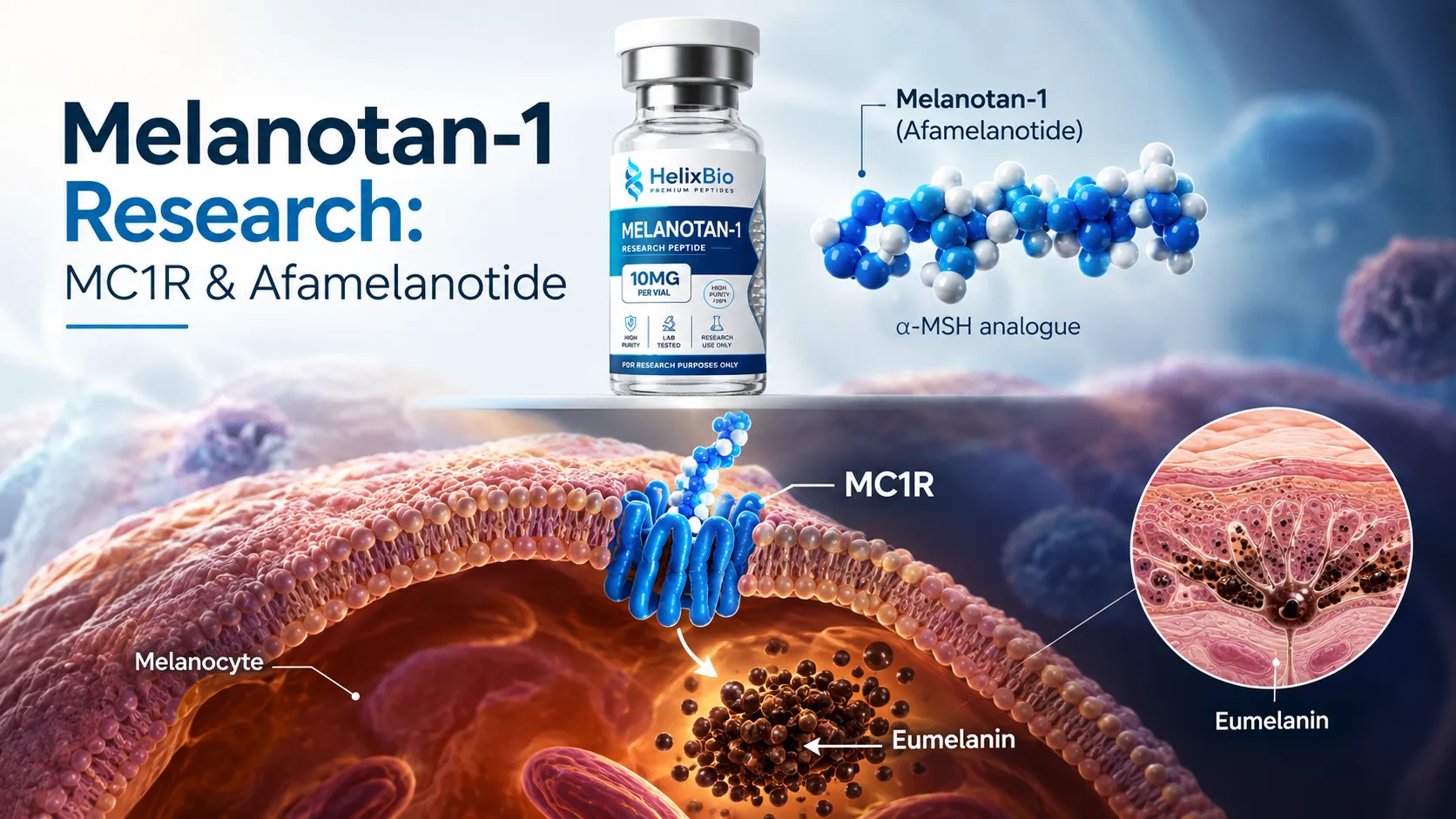
MC1R is a Gs-coupled receptor; agonist binding raises cAMP, activates PKA and CREB, induces MITF, and upregulates tyrosinase, shifting synthesis toward eumelanin.
MC1R loss-of-function variants associated with red hair and fair skin show reduced signalling, so melanocyte donor genotype is an experimental variable in agonist studies.
Afamelanotide is FDA-approved only as SCENESSE, a 16 mg controlled-release subcutaneous implant, and only to increase pain-free light exposure in adults with erythropoietic protoporphyria.
Melanotan II, a different compound, was removed from 503A Category 2 effective 22 April 2026 and is scheduled for advisory committee review before the end of February 2027.
Search results for Melanotan-1 split into two unhelpful halves. One half is consumer tanning content that skips the pharmacology entirely. The other is vendor copy that compresses receptor affinity, agonism and selectivity into a single sentence about MC1R, usually the sentence "highly selective for MC1R." Neither answers the questions a researcher actually has: what the molecule is, what the receptor data support, and how a research-grade vial relates to an approved pharmaceutical built on the same active.
Featured In This Article
Melanotan-1
RESEARCH PEPTIDE
Highly purified synthetic peptide prepared for rigorous laboratory research.
$61.00
What is Melanotan-1?
Melanotan-1 is a synthetic thirteen-residue analog of α-melanocyte-stimulating hormone (α-MSH) studied as an agonist at melanocortin receptors, with its highest reported affinity at the melanocortin 1 receptor (MC1R). It carries the international nonproprietary name afamelanotide and appears across the literature as Melanotan I, MT-I, NDP-MSH and [Nle⁴,D-Phe⁷]-α-MSH. Those are names for one molecule, registered under CAS 75921-69-6.
That single fact resolves most of the confusion in this search space. What differs between "Melanotan-1" and "afamelanotide" is not chemistry. It is everything downstream of chemistry: formulation, manufacturing controls, clinical evidence and regulatory status.
Molecular identity and what the two substitutions change
Native α-MSH runs Ac-Ser-Tyr-Ser-Met-Glu-His-Phe-Arg-Trp-Gly-Lys-Pro-Val-NH₂. Melanotan-1 changes exactly two positions: methionine at position 4 becomes norleucine, and the L-phenylalanine at position 7 is replaced by its D-enantiomer. The published sequence is Ac-Ser-Tyr-Ser-Nle-Glu-His-D-Phe-Arg-Trp-Gly-Lys-Pro-Val-NH₂, molecular formula C78H111N21O19, average mass near 1646.9 g/mol.
Both substitutions were made in the same 1980 design work, and both were aimed at resistance to enzymatic degradation and prolonged biological activity rather than at receptor selectivity. That distinction matters when reading vendor claims that attribute the design to selectivity engineering.
The eighteen-dalton arithmetic
Replacing methionine with norleucine swaps a sulfur atom for a methylene group. The arithmetic is clean: native α-MSH sits near 1664.9 g/mol, Melanotan-1 near 1646.9, a difference of roughly 18 daltons. One mass spectrometry run separates the analog from its parent hormone, which is a useful orthogonal check when a sample's provenance is uncertain.
The same substitution removes the only methionine in the sequence, and with it the +16 dalton methionine sulfoxide impurity that complicates purity chromatograms for Met-containing peptides. Melanotan-1's degradation profile is therefore driven by other routes, including deamidation at the C-terminal valinamide, rather than by oxidation of a sulfur side chain.
The substitution mass spectrometry cannot see
The D-phenylalanine at position 7 is the design's other half, and it is analytically silent. An enantiomer has the same molecular formula and the same mass as its L-counterpart. A mass spectrum consistent with 1646.9 confirms that a sample has the right composition. It does not confirm that position 7 carries the D-configuration, and the D-configuration is the reason the molecule resists proteolysis in the first place.
Mass confirmation alone cannot establish the stereochemistry at position 7. Distinguishing [Nle⁴,D-Phe⁷]-α-MSH from an all-L analog of identical mass requires a chirality-sensitive method, such as chiral chromatography or amino acid analysis after hydrolysis with derivatisation. Researchers should confirm what identity method a lot was actually released against rather than assuming a mass result covers configuration.
This is a recurring class of problem in peptide documentation, and it is worth reading a certificate against the same standard used for any other compound. Our guide to reading a peptide certificate of analysis covers the identity, purity and content fields separately, which is the right frame here.
MC1R and the selectivity question
The most common overstatement about this compound is that it is MC1R-selective. Reference-standard characterisation data do not support an unqualified version of that claim. Reported inhibition constants place Melanotan-1 in the sub-nanomolar to low-nanomolar range at four melanocortin receptor subtypes, not at one.
Receptor
Reported Ki
Relative to MC1R
Interpretation
MC1R
0.085 nM
Reference
Highest reported affinity
MC3R
0.4 nM
About 5-fold weaker
Still sub-nanomolar
MC4R
3.8 nM
About 45-fold weaker
Low nanomolar
MC5R
5.1 nM
About 60-fold weaker
Low nanomolar
A five-fold separation between MC1R and MC3R is not selectivity in any pharmacological sense. The defensible statement is that Melanotan-1 is a broadly acting melanocortin agonist whose highest reported affinity is at MC1R, and whose most-studied biological readout is pigmentary. Reported values also vary with assay system, cell background and radioligand, so a single number should be read as one measurement rather than a constant.
Affinity, agonism and selectivity are three different measurements
These terms are used interchangeably across commercial pages, and they answer different questions. Affinity describes how tightly a ligand occupies a receptor and is measured as a binding constant. Agonism describes whether occupancy produces a signal, and how much, usually read as a second-messenger response. Selectivity is a ratio between subtypes, and it only means anything once the same assay has been run across all of them. A compound can bind tightly, signal weakly, and be non-selective, all at once. Melanotan-1 binds tightly at MC1R, produces a robust cAMP response, and is not subtype-selective.
From receptor to pigment: the signalling route
MC1R is a Gs-coupled receptor expressed on melanocytes. Agonist binding activates adenylyl cyclase, raising intracellular cAMP, which activates protein kinase A. PKA phosphorylates the transcription factor CREB, which drives expression of microphthalmia-associated transcription factor (MITF). MITF in turn upregulates the melanogenic enzymes, including tyrosinase and dopachrome tautomerase, and the pathway output is a shift toward eumelanin over pheomelanin.
That chain is well characterised, and it is the reason MC1R agonism and pigmentation research are discussed together. It is also where evidence levels need to stay visible. Receptor occupancy is a binding measurement. cAMP accumulation is a signalling measurement. Melanin content in a cell model is a biochemical outcome. Skin pigmentation in a person is a clinical outcome. Each step is a separate experiment, and a result at one level does not establish the next.
Why donor genotype is a variable, not a footnote
MC1R is one of the more polymorphic loci in the human genome. Variants associated with the red hair and fair skin phenotype, including R151C, R160W and D294H, show reduced signalling capacity relative to the wild-type receptor. In practical terms, the magnitude of a melanocortin agonist response in primary human melanocytes depends partly on the genotype of the donor those cells came from. Studies of NDP-MSH in human subjects have examined exactly this question. A cell-model result reported without receptor genotype is not necessarily reproducible in a different donor's cells, and that belongs in the methods section rather than in a caveat at the end.
Melanotan-1 and afamelanotide: one molecule, two contexts
Afamelanotide is the nonproprietary name for the same thirteen-residue peptide. SCENESSE is the brand name of the approved pharmaceutical product built on it, and the two are not interchangeable terms.
The approved indication is narrow and specific: increasing pain-free light exposure in adults with a history of phototoxic reactions from erythropoietic protoporphyria (EPP). It is not an approval for pigmentation, cosmetic use, or any other endpoint, and it attaches to a product, not to a chemical name.
The pharmacokinetic figures make the same point in a way that is easy to check. The peptide itself has a short reported elimination half-life, on the order of tens of minutes. The approved label reports a median time to maximum concentration near 36 hours and an apparent half-life around 15 hours. Those figures describe the release characteristics of the implant, not an intrinsic property of the molecule. Reading them as a property of Melanotan-1 is a category error, and it is the same confusion described in our article on half-life versus shelf-life, where a number that belongs to a system gets attributed to a compound.
What the human record actually shows
The evidence base for this molecule is unusually long, running from the early 1980s to a modern approval, and it is worth separating by tier.
Biochemical and receptor work established potency and prolonged activity relative to native α-MSH, and produced the substitutions that define the analog.
Cell and tissue studies in human melanocytes established the cAMP-dependent shift toward eumelanin synthesis.
Early human studies in the 1990s, using subcutaneous administration of the peptide in solution, reported measurable increases in skin pigmentation; a dose-ranging study found no additional pigmentation beyond the lowest level tested.
Later human work reported that the increase was specifically in eumelanin, and a controlled study in fair-skinned volunteers reported increased pigmentation alongside reduced markers of UV-induced damage.
The pivotal evidence is two randomised, placebo-controlled trials of the implant in EPP patients, published together in 2015, which supported the 2019 approval.
The shape of that record matters more than any single result. The strongest data are product-specific and population-specific: a defined implant, in patients with a rare metabolic disease, measuring time spent in sunlight without pain. None of it transfers to an unapproved material, and none of it establishes an outcome for a different formulation.
Regulatory status, and a distinction that is routinely inverted
The melanocortin with FDA approval and the melanocortin currently moving through the compounding-list process are different molecules.
Afamelanotide is the active ingredient of an approved prescription product distributed through licensed pharmaceutical channels. It does not sit inside the 503A bulk drug substances framework, which governs substances nominated for use in compounding rather than actives of approved drugs.
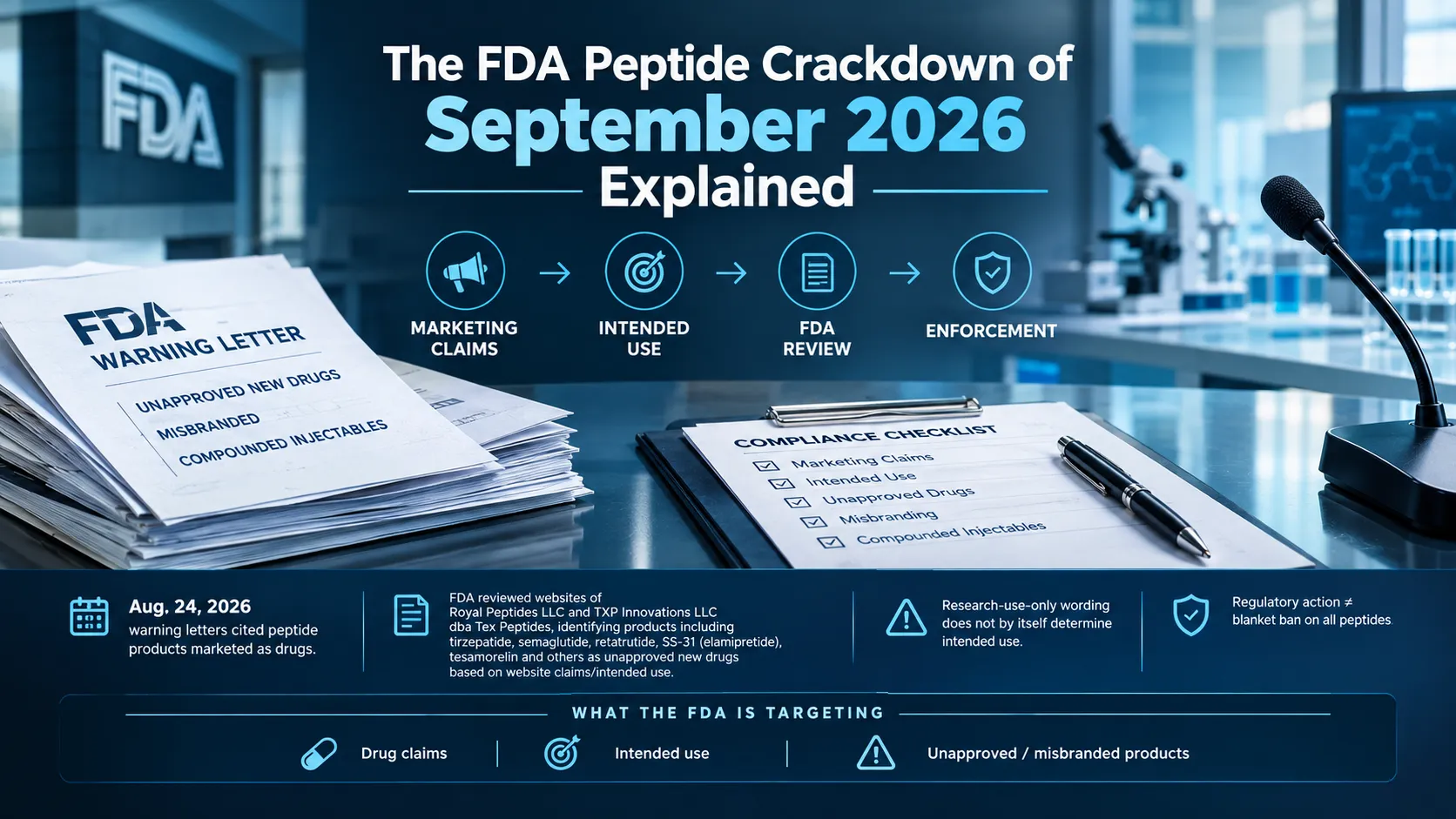
Melanotan II is a different compound: a shorter cyclic analog with its own receptor profile. It was among twelve peptide substances removed from Category 2 of FDA's interim 503A list effective 22 April 2026, following withdrawal of the underlying nominations, and FDA has said it will be reviewed by the Pharmacy Compounding Advisory Committee before the end of February 2027. Removal from Category 2 is a procedural step, not an authorisation. Our 503A bulks list explainer covers what that process does and does not change, and the receptor-level differences between the two melanocortins are set out in our PT-141 and Melanotan II comparison.
So "is Melanotan FDA approved" has no single answer, because the query does not name a molecule. One melanocortin analog holds a narrow approval as a specific implant product. Another has no approval and an unresolved compounding status. Research-use-only material of either kind is neither, and the broader position is covered in our RUO compliance overview.
Handling and documentation for research material
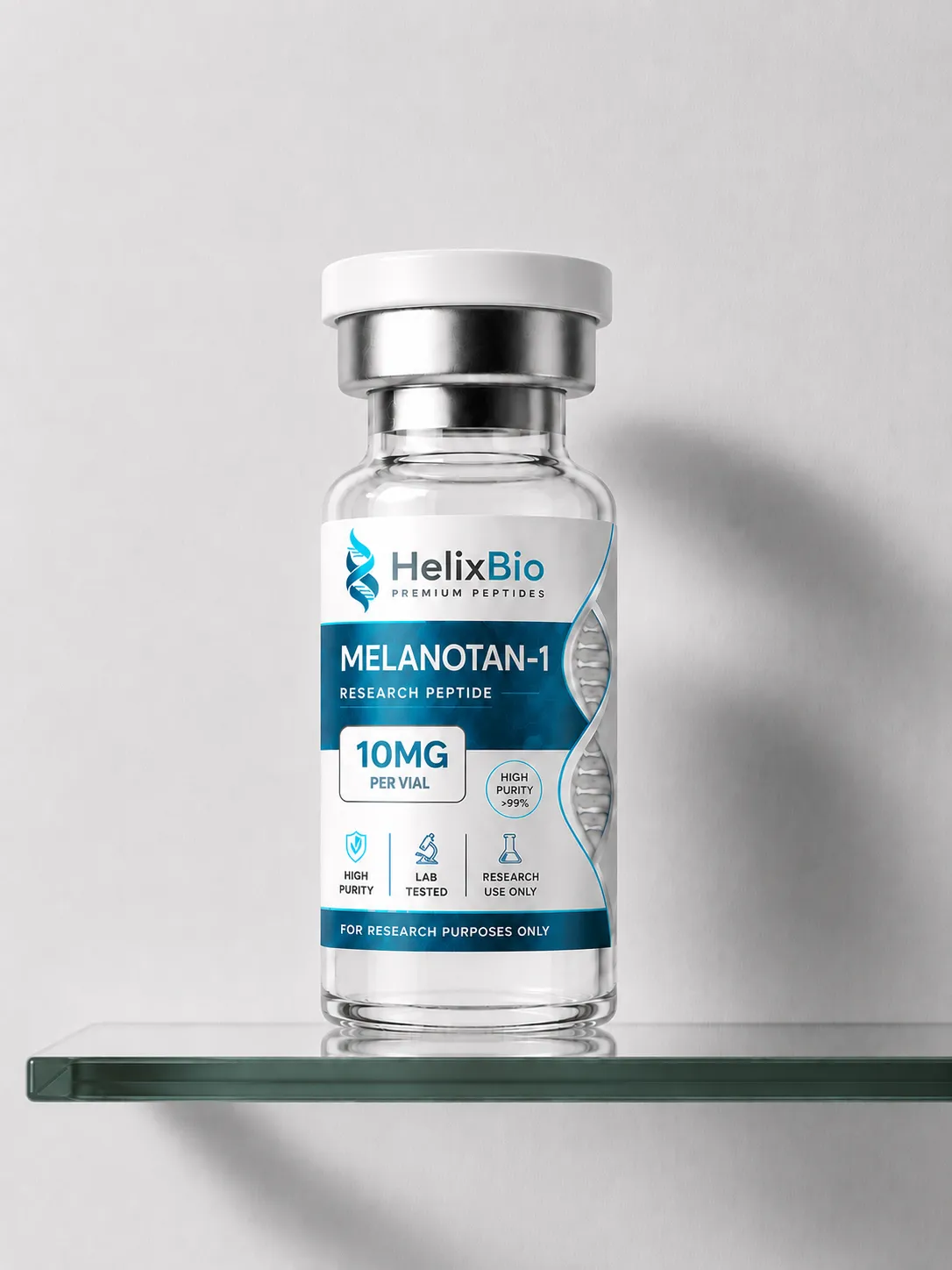
For a lot of [Melanotan-1 research material](/product/melanotan-1), the documentation questions that matter most are identity method, purity method and net peptide content, in that order. Mass confirms composition, HPLC area percent describes chromatographic purity under one method, and neither figure tells you how much peptide is in the vial. Salt form and residual solvent both shift the mass basis.
Two further points are specific to this sequence. It contains tryptophan and tyrosine, so ultraviolet detection near 280 nm is available as an orthogonal check, unlike many short research peptides where that route is unusable. And the C-terminal valinamide is a deamidation site, producing an approximately 1 dalton shift that is easy to miss on a low-resolution instrument.
α-MSH is also the parent of a separate research fragment: the C-terminal tripeptide lysine-proline-valine, discussed in our KPV research article. That fragment does not carry the melanocortin receptor binding motif, which is a useful reminder that shared lineage within the α-MSH family does not imply shared receptor behaviour.
What is established, and what is not
Established: the sequence and molecular identity; MC1R agonist activity with the highest reported affinity of four melanocortin subtypes; the cAMP-PKA-CREB-MITF-tyrosinase route to eumelanin synthesis; that afamelanotide and Melanotan-1 name the same active; and that one implant product carrying that active is approved for one rare-disease indication.
Not established: that the compound is MC1R-selective in any strict sense; that receptor affinity data predict a magnitude of biological response in a given model; that clinical results obtained with a controlled-release implant in EPP patients describe any other formulation; or that similar nomenclature implies similar manufacturing standard, purity, or evidentiary support. Those four inferences are the ones the surrounding literature most often makes silently.
Got Questions?
Frequently Asked Questions
Melanotan-1 is a synthetic thirteen-residue analog of α-melanocyte-stimulating hormone, studied as a melanocortin receptor agonist with its highest reported affinity at MC1R. It is also known as Melanotan I, MT-I, NDP-MSH and [Nle⁴,D-Phe⁷]-α-MSH, and it carries the international nonproprietary name afamelanotide.
At the level of the molecule, yes: both names describe [Nle⁴,D-Phe⁷]-α-MSH under CAS 75921-69-6. At the level of the product, no. Afamelanotide reaches patients only as an approved implant with pharmaceutical manufacturing controls and clinical evidence attached to that specific formulation, none of which transfers to a research-use-only material.
The reported sequence is Ac-Ser-Tyr-Ser-Nle-Glu-His-D-Phe-Arg-Trp-Gly-Lys-Pro-Val-NH₂, with an acetylated N-terminus and a C-terminal amide. The molecular formula is C78H111N21O19 and the average mass is near 1646.9 g/mol.
Two positions differ. Methionine at position 4 is replaced by norleucine, and the L-phenylalanine at position 7 is replaced by its D-enantiomer. Both changes were introduced to increase resistance to enzymatic degradation and prolong biological activity relative to the parent hormone.
Not in a strict pharmacological sense. Reported inhibition constants are sub-nanomolar at MC1R and MC3R and low-nanomolar at MC4R and MC5R, which is a narrow separation across four subtypes. The defensible description is a broadly acting melanocortin agonist whose highest reported affinity is at MC1R.
MC1R is a Gs-coupled receptor that activates adenylyl cyclase on agonist binding. Rising cAMP activates protein kinase A, which phosphorylates CREB and induces MITF. MITF upregulates tyrosinase and related melanogenic enzymes, shifting synthesis toward eumelanin rather than pheomelanin.
Only partially. Mass spectrometry confirms composition and separates the analog from native α-MSH by roughly 18 daltons. It cannot distinguish the D-phenylalanine at position 7 from an L-configured analog, because enantiomers share a molecular mass. Configuration requires a chirality-sensitive method.
Yes. Human studies of the peptide in solution date to the early 1990s and reported measurable increases in skin pigmentation, with later work reporting that the increase was specifically in eumelanin. The pivotal evidence is two randomised placebo-controlled trials of the implant formulation in erythropoietic protoporphyria patients, published in 2015.
Afamelanotide is approved as SCENESSE, a 16 mg controlled-release subcutaneous implant, approved on 8 October 2019 to increase pain-free light exposure in adults with a history of phototoxic reactions from erythropoietic protoporphyria. The approval covers that product and that indication only.
No. An approval attaches to a specific product with its own manufacturing, formulation, testing and labelling, not to a chemical name. Research-use-only material sharing the same active moiety carries none of that regulatory standing and no approved indication.
Because they measure different things. The peptide in solution has a short reported elimination half-life on the order of tens of minutes, while the approved product's label reports an apparent half-life near 15 hours. The longer figure reflects controlled release from the implant, not an intrinsic property of the molecule.
They are separate compounds. Melanotan-1 is a linear thirteen-residue α-MSH analog; Melanotan II is a shorter cyclic analog with a different receptor activity profile. Their regulatory positions also differ, since the active in Melanotan-1 underpins an approved product while Melanotan II is under advisory committee review for the 503A bulks list.