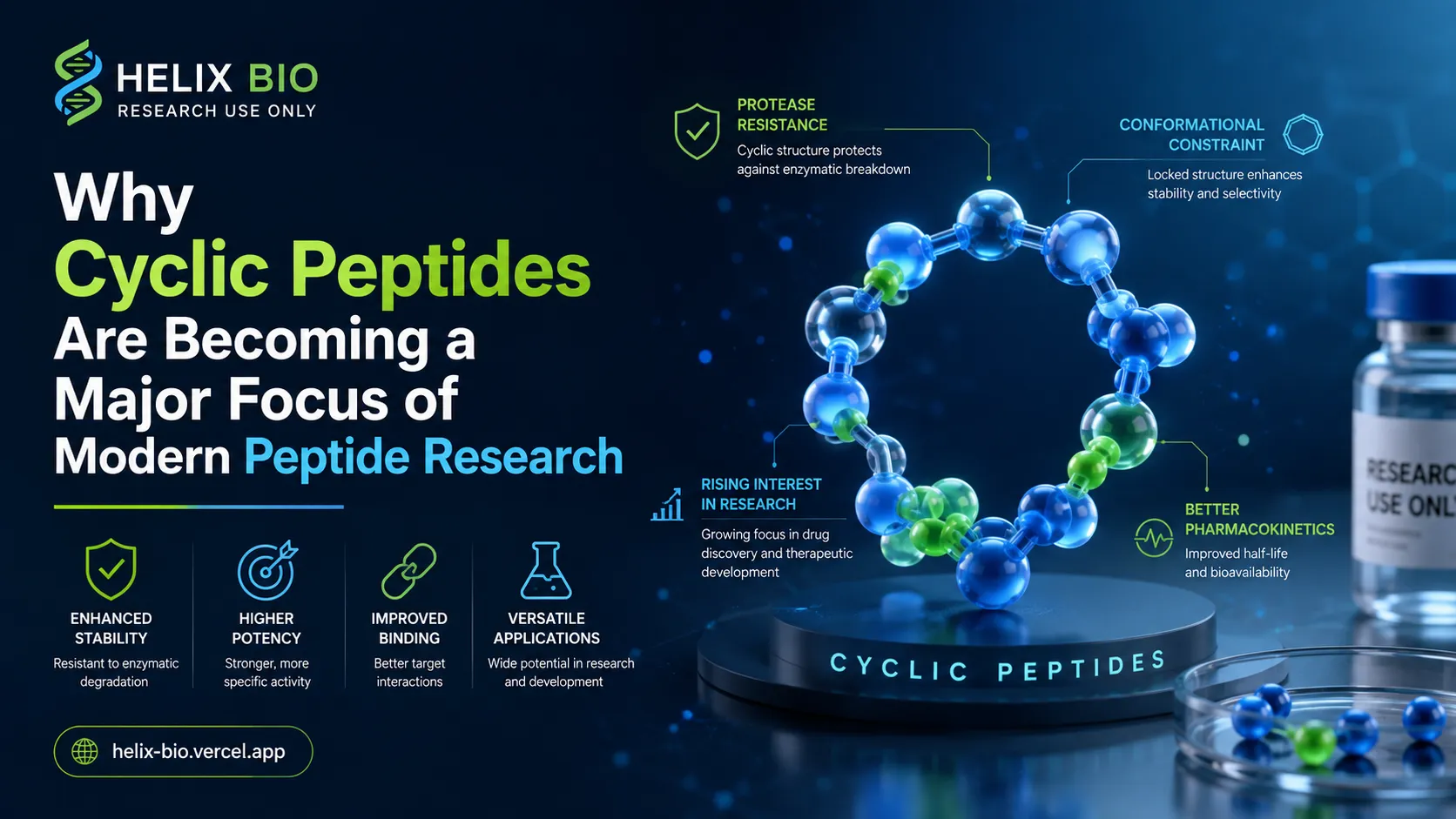
- A cyclic peptide is a peptide whose backbone or side chains form a closed ring rather than an open chain with free N- and C-termini.
- Cyclization improves proteolytic stability by removing the free termini that aminopeptidases and carboxypeptidases require as entry points.
- Ring closure pre-organizes the peptide conformation, which reduces the entropic cost of binding and typically sharpens target selectivity.
- Some cyclic peptides achieve passive membrane permeability through intramolecular hydrogen bonding and N-methylation, a property described as chameleonic behavior.
- The four main cyclization strategies are head-to-tail, side-chain to side-chain, head-to-side-chain, and backbone cyclization.
- mRNA display, phage display, and DNA-encoded libraries made constrained macrocyclic binders systematically discoverable rather than serendipitous.
- Cyclic peptides are studied most heavily against protein-protein interfaces that small molecules and antibodies handle poorly.
- A credible research peptide certificate of analysis reports batch-specific HPLC purity with a chromatogram and confirms identity by mass spectrometry.
Cyclic peptides have moved from a chemical curiosity to one of the busiest areas in modern peptide research. This guide explains what cyclization actually does to a peptide backbone, why ring closure changes stability and membrane permeability, how cyclic peptides are synthesized and screened, and what laboratory teams should verify before sourcing them. Every section is framed for research use only, with no human-use, dosing, or therapeutic guidance.

Melanotan-2
RESEARCH PEPTIDE
Melanotan-2 is a synthetic cyclic analog of alpha-melanocyte-stimulating hormone (α-MSH) that has been studied in laboratory research involving melanocortin receptors, peptide structure, receptor signaling, and related cellular pathways. It is structurally distinct from Melanotan-1 and is frequently used as a research ligand when investigators are examining melanocortin receptor pharmacology. Helix Bio provides Melanotan-2 as a research-use-only peptide for qualified laboratory and scientific applications. Researchers should consult the applicable lot-specific Certificate of Analysis (COA) and product documentation before incorporating the material into an experimental workflow.
PT-141
RESEARCH PEPTIDE
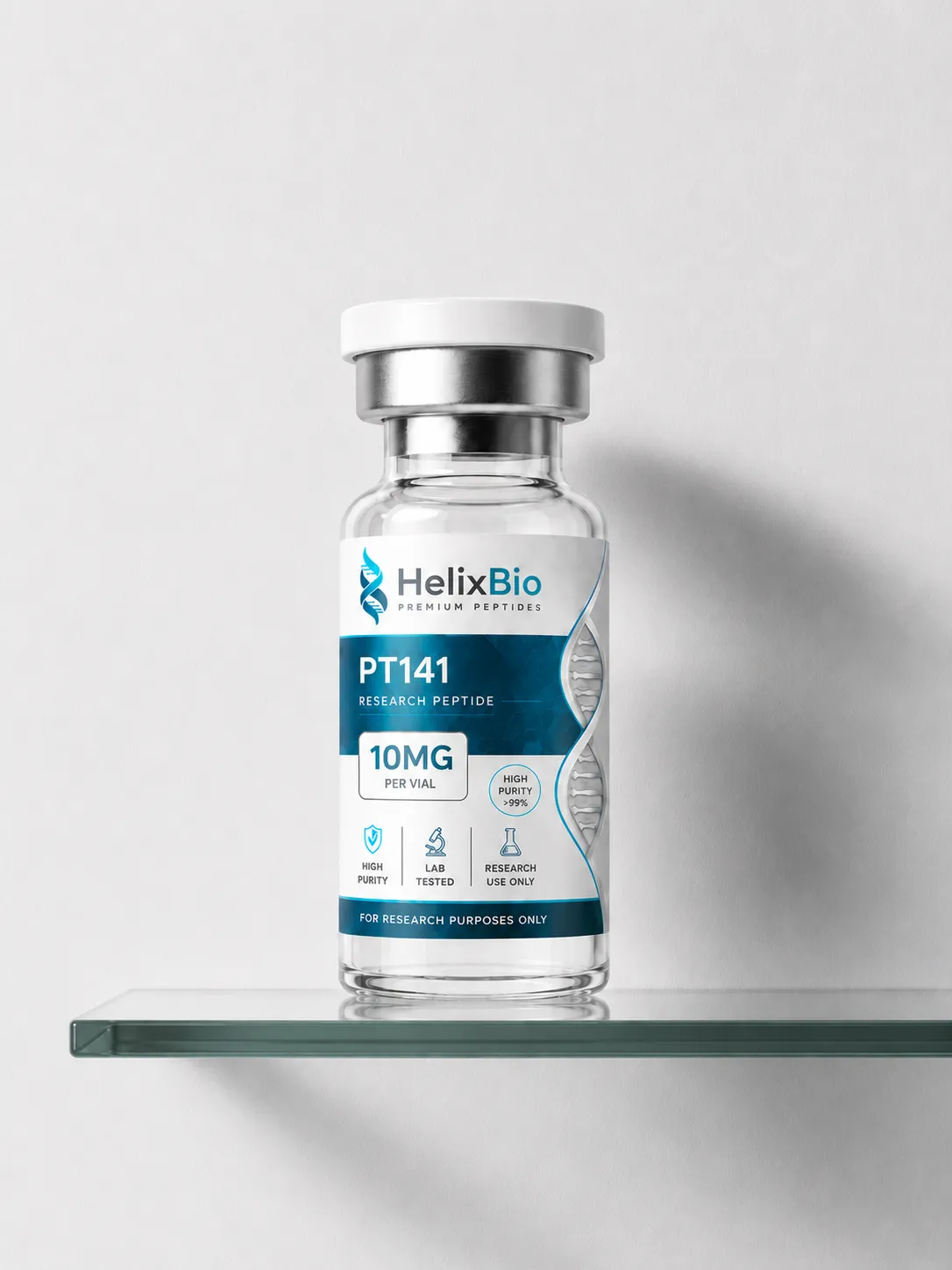
PT-141, also known as bremelanotide, is a synthetic cyclic peptide analog of alpha-melanocyte-stimulating hormone (α-MSH) used in research involving melanocortin receptor biology, peptide-receptor interactions, and cellular signaling. The compound has been investigated across melanocortin receptor subtypes, including MC1R, MC3R, MC4R, and MC5R. Helix Bio supplies PT-141 as a research-use-only peptide for qualified laboratory and scientific applications. Researchers should review the current lot-specific Certificate of Analysis (COA), analytical documentation, and product specifications before incorporating the material into an experimental workflow.
What Are Cyclic Peptides?
A cyclic peptide is a peptide whose backbone or side chains form a closed ring rather than an open chain with free N- and C-termini. Cyclization removes the terminal ends that exopeptidases recognize, locks the molecule into a narrower set of conformations, and produces a scaffold that behaves very differently from a linear sequence built from the same amino acids.
That structural difference places cyclic peptides in what chemists call the middle space. Small molecules bind deep, well-defined pockets. Biologics bind large surfaces but stay outside the cell. Cyclic peptides sit between them, combining enough surface area to engage flat protein interfaces with enough rigidity and compactness to behave, in some cases, like a drug-like small molecule.
A macrocyclic peptide is the broader structural label applied to peptide rings of roughly twelve atoms or more. In practice, most research literature treats cyclic peptides and macrocyclic peptides as overlapping categories, with macrocycle used when the emphasis falls on ring geometry rather than on amino acid composition.
Cyclic vs Linear Peptides vs Small Molecules
Attribute | Small molecule | Linear peptide | Cyclic peptide |
|---|---|---|---|
Typical molecular weight | Under 500 Da | 500–5,000 Da | 500–2,000 Da |
Conformational freedom | Low | Very high | Constrained by the ring |
Protease susceptibility | Not applicable | High | Substantially reduced |
Target surface suited to | Deep binding pockets | Shallow or extended epitopes | Flat protein–protein interfaces |
Passive membrane permeability | Usually good | Usually poor | Variable, sometimes good |
Synthesis complexity | Moderate | Low | Higher, ring closure dependent |
The row that drives most of the current research interest is conformational freedom. A linear peptide samples an enormous number of shapes in solution, so binding costs a large entropic penalty. Ring closure pays much of that penalty in advance.
Why Cyclization Changes Peptide Behaviour
Cyclization improves three properties at once: proteolytic stability, target selectivity, and in some scaffolds, passive membrane permeability. Those three gains are the reason publication and patent activity in the category has climbed steadily for two decades.
Protease Resistance
Cyclic peptides resist enzymatic degradation because head-to-tail cyclization eliminates the free N- and C-termini that aminopeptidases and carboxypeptidases require as entry points. Endopeptidases can still cleave internal bonds, but the constrained backbone often fails to adopt the extended conformation those enzymes need in their active sites. The practical result reported across the literature is longer serum stability and a longer plasma half-life in research models than the matched linear sequence.
Conformational Rigidity and Selectivity
Scaffold rigidity does more than protect against proteases. A pre-organized ring holds side chains in a fixed spatial arrangement, which sharpens discrimination between closely related receptors. Many cyclic scaffolds stabilize a defined beta-turn or act as an alpha-helix mimetic, presenting a binding face that a flexible chain would only occasionally form. Selectivity gains of this kind are frequently reported alongside modest affinity gains rather than dramatic ones.
Membrane Permeability and Oral Bioavailability
Peptides are normally poor candidates for passive diffusion because amide bonds hold water tightly. Some cyclic peptides overcome this through intramolecular hydrogen bonding, which shields polar amide protons and lowers effective polar surface area in a lipid environment. Researchers describe this shape-shifting between polar and nonpolar states as chameleonic behavior.
Cyclosporine remains the reference case. Its ring, extensive N-methylation, and internal hydrogen bonding give it oral bioavailability despite sitting far outside Lipinski's rule of five — the property space now described as beyond rule of five. That precedent is a large part of why medicinal chemists keep returning to macrocycles.
The Four Main Cyclization Strategies
Peptide cyclization is usually classified by which parts of the molecule are joined. Four strategies dominate the literature:
- Head-to-tail cyclization joins the N-terminus to the C-terminus through a normal amide bond, producing a fully backbone-cyclic ring with no free termini.
- Side-chain to side-chain cyclization links two amino acid side chains, most commonly through a disulfide bridge or a lactam bridge.
- Head-to-side-chain cyclization connects one terminus to a side chain, giving an asymmetric ring plus a residual tail.
- Backbone cyclization installs a bridge between backbone nitrogen atoms, often using purpose-built building blocks.
Bridge Chemistry Compared
Bridge type | Formed from | Typical characteristics |
|---|---|---|
Disulfide bridge | Two cysteine residues | Easy to form, reversible, sensitive to reducing conditions |
Lactam bridge | Lysine plus aspartate or glutamate | Chemically stable, widely used in research peptides |
Thioether linkage | Cysteine plus a halo-acetyl group | Stable to reduction, common in stapled and bicyclic designs |
Click chemistry or ring-closing metathesis | Azide/alkyne or olefin pairs | Bio-orthogonal, useful for staples and unnatural scaffolds |
Stapled peptides use a hydrocarbon staple, usually installed by ring-closing metathesis, to lock a helical segment in place. Bicyclic peptides add a second ring, typically by reacting three cysteines with a small central scaffold, which further restricts conformation and increases the buried binding surface.
Ring Size in Cyclic Peptide Design
Ring size describes the number of atoms in the closed macrocycle and is one of the primary design variables in cyclic peptide chemistry. Small rings such as a cyclic tetrapeptide or cyclic pentapeptide are highly rigid but strained and often difficult to close. Larger rings close more easily and present more surface area, but they recover conformational freedom and lose some of the entropic advantage that motivated cyclization.
How Cyclic Peptides Are Synthesized
Most cyclic peptides begin as linear chains built by solid-phase peptide synthesis (SPPS), the method Robert Bruce Merrifield introduced in 1963 and for which he received the Nobel Prize in Chemistry in 1984. Modern laboratories run SPPS almost universally with Fmoc chemistry and orthogonal protecting groups, which allow one specific side chain to be unmasked while the rest of the molecule stays protected.
Cyclization then happens either on the resin or in dilute solution. On-resin cyclization exploits the pseudo-dilution effect, where resin-bound chains are physically separated from one another, which favours the intramolecular ring closure over intermolecular oligomerisation. Solution-phase cyclization achieves the same outcome through high dilution.
Head-to-tail cyclization of small rings is the step most prone to epimerization at the activated C-terminal residue. Coupling reagent choice, base loading, and reaction temperature are the variables research groups adjust first when a cyclization produces diastereomeric by-products.
Two backbone modifications appear constantly alongside cyclization. N-methylation removes an amide hydrogen-bond donor, which usually improves passive membrane permeability and adds protease resistance. D-amino acid substitution installs residues that mammalian proteases cleave poorly and that can favour the turn geometry a given ring requires. Native chemical ligation offers a further route for assembling larger cyclic scaffolds from unprotected fragments.
Discovery Platforms Driving the Shift
The current momentum behind cyclic peptides is as much a screening story as a chemistry story. Three platforms changed what is findable.
mRNA display couples each peptide to its own encoding mRNA, allowing libraries in the range of a trillion members to be selected against a target in vitro. The RaPID system developed by Hiroaki Suga extended this to macrocyclic libraries containing non-proteinogenic amino acids, which is why mRNA display is now closely associated with cyclic peptide discovery.
Phage display, built on the foundations that earned Greg Winter a share of the 2018 Nobel Prize in Chemistry, presents peptide libraries on bacteriophage coat proteins. Chemical modification of displayed cysteines converts linear phage libraries into bicyclic ones, giving a route to constrained binders from an established platform.
DNA-encoded libraries (DEL) tag each compound with a DNA barcode, permitting pooled selection and sequencing-based readout across very large synthetic collections. Alongside these, computational peptide design, molecular dynamics simulation, and AI protein structure prediction now shorten the loop between a selected binder and an optimised scaffold.
Where Cyclic Peptides Appear in Research
The application that best explains the field's growth is protein–protein interaction inhibition. Interfaces of that kind are typically flat and broad, which frustrates small molecules and sits out of reach for antibodies when the target is intracellular. Constrained macrocycles bridge that gap, which is why they are so often discussed in the context of undruggable target modulation.
Beyond that, cyclic scaffolds recur in antimicrobial peptide research, oncology target engagement, immunomodulation studies, diagnostic imaging probes, and biosensor development. Natural cyclic peptides are also widespread — plants, fungi, and bacteria all produce them, and the cyclotide family found in plants combines head-to-tail cyclization with a cystine knot to produce exceptionally robust scaffolds.
Well-Known Cyclic Peptides
Compound | Class | Cyclization | Why it is referenced |
|---|---|---|---|
Cyclosporine A | Cyclic undecapeptide | Head-to-tail, heavily N-methylated | Canonical example of an orally bioavailable macrocycle |
Vancomycin | Glycopeptide | Multiple cross-linked rings | Macrocyclic reference compound in antimicrobial literature |
Octreotide | Somatostatin analogue | Disulfide bridge | Widely cited disulfide-cyclized analogue |
Polymyxin B | Cyclic lipopeptide | Lactam ring plus lipid tail | Classic cyclic antimicrobial scaffold |
Daptomycin | Cyclic lipopeptide | Ester-linked macrolactone | Frequently cited lipopeptide architecture |
Gramicidin S | Cyclic decapeptide | Head-to-tail, symmetric | Historical model system for cyclic peptide structure |
Kalata B1 | Cyclotide | Head-to-tail plus cystine knot | Reference scaffold in cyclotide research |
Melanotan II | Lactam-bridged heptapeptide | Side-chain lactam | Commonly studied cyclic research peptide |
PT-141 (Bremelanotide) | Cyclic heptapeptide | Lactam bridge | Cyclic melanocortin research compound |
Two of these sit inside the research-peptide catalogue that laboratories order routinely: Melanotan-2, a lactam-bridged heptapeptide, and its more receptor-selective cyclic relative PT-141. Cyclic lactam-bridged compounds are a useful reminder that cyclization is not an exotic academic technique — it already defines several compounds in everyday research use.
Stability, Storage and Handling in the Laboratory
Cyclization improves biological stability, not chemical indestructibility. A cyclic peptide still degrades through oxidation, hydrolysis, aggregation, and repeated freeze–thaw cycling, and disulfide-bridged scaffolds are additionally sensitive to reducing conditions in solution.
Form | Typical storage | Practical notes |
|---|---|---|
Lyophilized, unopened | −20 °C or colder | The most stable form; protect from light and moisture |
Lyophilized, short term | 2–8 °C | Acceptable for near-term work in most protocols |
In transit | Ambient with cold packs | Short ambient excursions are generally tolerated in lyophilized form |
Reconstituted | 2–8 °C | Stability shortens considerably once in solution |
Reconstituted, long term | Aliquoted and frozen | Aliquoting avoids repeated freeze–thaw damage |
Researchers typically allow a vial to equilibrate to room temperature before opening, add solvent slowly down the vial wall rather than directly onto the pellet, and avoid vortexing. Cloudiness, visible particulates, a discoloured cake, or a collapsed pellet are the usual visual indicators that a vial should be set aside and verified analytically. Storage handling errors are covered in more depth in our guide to peptide storage mistakes and potency loss, and solvent selection in the peptide reconstitution guide.
Cyclic peptides supplied by research chemical vendors are research use only. They are not drugs, not dietary supplements, and not intended for human or veterinary administration, diagnostic use, or any application outside a controlled laboratory setting.
Purity Verification and Documentation
Purity matters more for cyclic peptides than for many linear sequences, because incomplete cyclization, dimerised by-products, and epimers can all appear as closely related species that a casual specification sheet will not distinguish.
Method | What it measures | What it cannot tell you |
|---|---|---|
HPLC purity analysis | Relative percentage of the main peak against detectable impurities | Whether the main peak is the intended molecule |
Mass spectrometry | Molecular mass, confirming identity and successful ring closure | Relative quantity of impurities |
The two methods answer different questions, which is why a credible certificate of analysis carries both. A batch-specific COA should identify the compound, state the batch or lot number, report HPLC purity with the chromatogram, confirm identity by mass spectrometry, and carry a test date and the name of the testing laboratory. A document with no lot number, no date, or no chromatogram is a marketing asset rather than an analytical record. Our walkthrough on how to read a peptide certificate of analysis covers each field in order.
Sourcing Cyclic Peptides Under Research Use Only Rules
Research use only labelling defines the permitted context of use: laboratory research, not human administration. Reputable suppliers reinforce that framing consistently across product pages, documentation, and marketing rather than hinting at personal use through wellness language.
Recurring red flags in this vertical include the following:
- No batch-specific certificate of analysis, or one COA reused across every lot
- Purity claimed as a marketing number with no chromatogram attached
- Any dosing, protocol, or benefit language aimed at a person rather than a research model
- No named third-party testing laboratory
- Pricing far below the cost of synthesising and testing the compound at the stated purity
- Vague shipping origin, or no cold-chain handling for temperature-sensitive material
Legal status and compliance framing are covered in are research peptides legal in the USA, and a practical vendor-evaluation sequence appears in the research peptide buying checklist.
Why the Field Is Consolidating Around Macrocycles
Three trends converge. Screening technology now reaches library sizes that make constrained binders findable rather than lucky. Synthetic methods for ring closure, N-methylation, and unnatural residue incorporation have matured to the point where optimisation cycles are routine. And the therapeutic problems attracting the most attention — intracellular protein–protein interactions, resistant bacterial targets, selective receptor engagement — are precisely the ones linear peptides and small molecules handle least well.
For laboratories, the practical consequence is that cyclic scaffolds are appearing in more catalogues, more protocols, and more published methods every year. Understanding what the ring actually does, and how to verify that the vial contains what the label claims, is now part of basic competence in peptide research.
Frequently Asked Questions
A cyclic peptide is a peptide whose backbone or side chains are joined to form a closed ring instead of an open chain. The ring removes the free N- and C-termini found in linear peptides and restricts how the molecule can fold in solution.
Linear peptides have free termini and sample many conformations in solution. Cyclic peptides are closed and conformationally constrained, which in research models generally produces greater protease resistance, longer serum stability, and sharper target selectivity than the matched linear sequence.
Head-to-tail cyclization eliminates the free N- and C-termini that exopeptidases require to begin degradation. The constrained backbone also resists adopting the extended conformation many endopeptidases need in their active sites, so enzymatic cleavage proceeds more slowly.
The four principal strategies are head-to-tail cyclization joining the two termini, side-chain to side-chain cyclization through a disulfide or lactam bridge, head-to-side-chain cyclization linking one terminus to a side chain, and backbone cyclization bridging backbone nitrogen atoms.
A macrocyclic peptide is a peptide containing a ring of roughly twelve atoms or more. In most research literature the terms cyclic peptide and macrocyclic peptide overlap, with macrocycle preferred when the discussion emphasises ring geometry rather than amino acid composition.
No. A bicyclic peptide contains two rings, usually formed by reacting three cysteine residues with a small central scaffold. A stapled peptide contains a single hydrocarbon bridge installed to lock a helical segment in place, most often by ring-closing metathesis.
Ring size is the number of atoms enclosed in the macrocycle. Smaller rings are more rigid but harder to close and can be strained. Larger rings close more readily and present more binding surface, but recover some conformational freedom.
Certain cyclic scaffolds shield polar amide protons through intramolecular hydrogen bonding, lowering effective polar surface area in lipid environments. Combined with N-methylation, this can support passive membrane permeability well outside conventional rule-of-five property space.
mRNA display physically links each peptide to its encoding mRNA, allowing in vitro selection from libraries of around a trillion members. The RaPID system extended the approach to macrocyclic libraries containing non-proteinogenic amino acids, making it central to cyclic peptide discovery.
Undruggable targets are proteins whose functional surfaces are flat and broad rather than pocket-shaped, which frustrates small molecules. Cyclic peptides present a larger constrained binding face, so research groups study them as protein-protein interaction inhibitors at those interfaces.
Cyclosporine, vancomycin, octreotide, polymyxin B, and daptomycin are all cyclic or macrocyclic peptide structures. They are referenced in the literature as architectural precedents; they are approved medicines and are not offered as research chemicals.
Yes. Plants, fungi, and bacteria all produce cyclic peptides. Cyclotides such as kalata B1 combine head-to-tail cyclization with a cystine knot, producing scaffolds noted in the literature for exceptional chemical and thermal robustness.
The linear chain is assembled by solid-phase peptide synthesis, then closed either on resin or under high dilution. Ring closure competes with intermolecular oligomerisation and can cause epimerization at the activated residue, so cyclization adds purification burden and lowers yield.
HPLC quantifies the main peak against detectable impurities, while mass spectrometry confirms molecular mass and successful ring closure. The two methods answer different questions, so a research-grade certificate of analysis should report both for the specific batch supplied.
Research use only defines the permitted context of use: controlled laboratory investigation. Compounds labelled this way are not drugs, dietary supplements, or diagnostic products, and are not intended for human or veterinary administration in any form.
- 01Merrifield RB. Solid Phase Peptide Synthesis. I. The Synthesis of a Tetrapeptide. Journal of the American Chemical Society. 1963;85(14):2149-2154.
- 02Driggers EM, Hale SP, Lee J, Terrett NK. The exploration of macrocycles for drug discovery - an underexploited structural class. Nature Reviews Drug Discovery. 2008;7(7):608-624.
- 03Passioura T, Katoh T, Goto Y, Suga H. Selection-based discovery of druglike macrocyclic peptides. Annual Review of Biochemistry. 2014;83:727-752.
- 04Zorzi A, Deyle K, Heinis C. Cyclic peptide therapeutics: past, present and future. Current Opinion in Chemical Biology. 2017;38:24-29.
- 05Vinogradov AA, Yin Y, Suga H. Macrocyclic Peptides as Drug Candidates: Recent Progress and Remaining Challenges. Journal of the American Chemical Society. 2019;141(10):4167-4181.
- 06Craik DJ, Fairlie DP, Liras S, Price D. The future of peptide-based drugs. Chemical Biology & Drug Design. 2013;81(1):136-147.

Helix Bio Chem Team
Research & Product Team
Our in-house team tracks published peptide research and translates it into clear, source-cited summaries for the research community.
Reviewed by in-house research chemists
support@helixbiochem.com