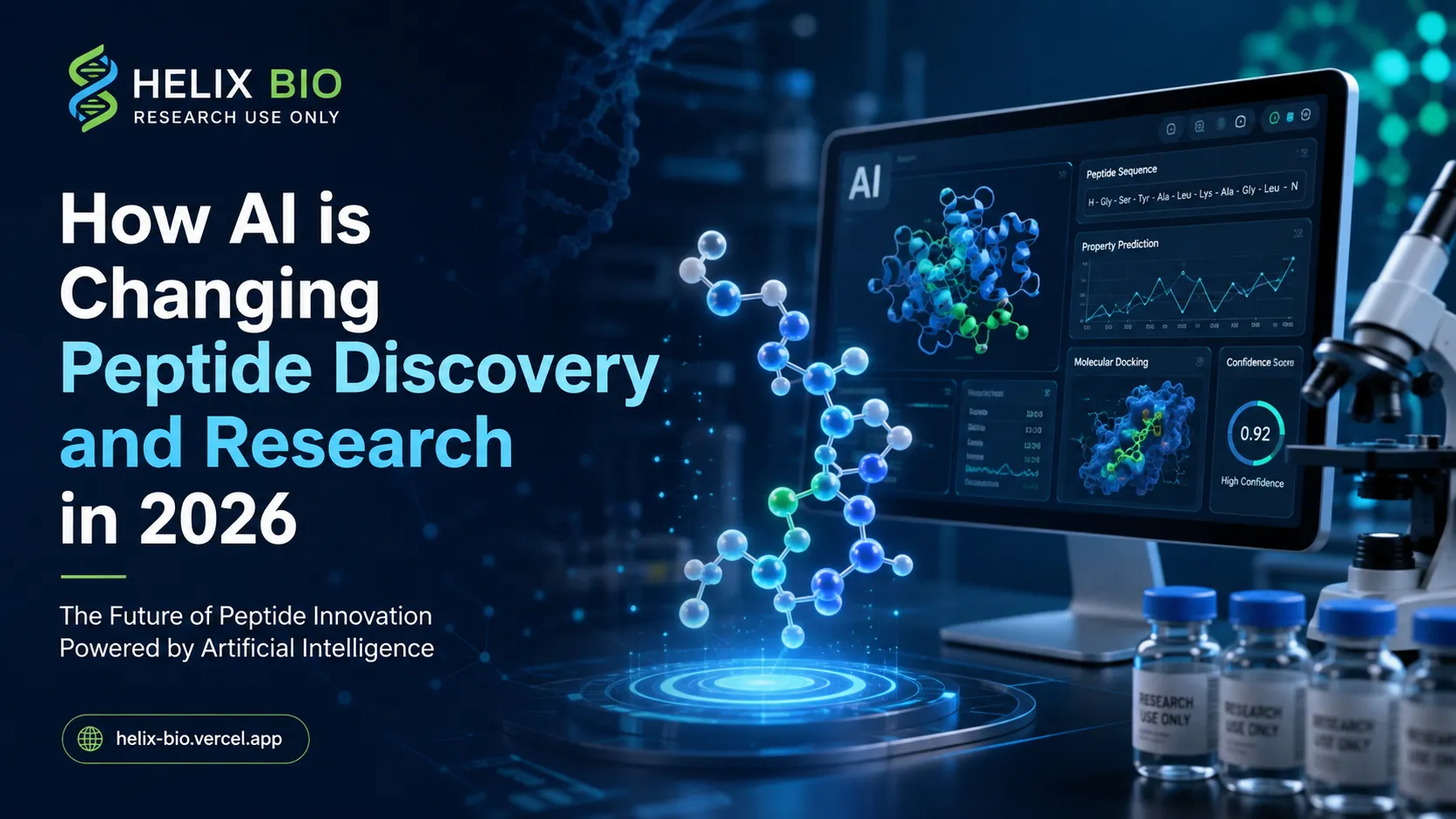
- AI peptide discovery uses diffusion models, protein language models, and structure prediction networks to design and rank peptide sequences before laboratory synthesis.
- De novo peptide design generates sequences with no natural template, while structure prediction verifies that those sequences fold as intended.
- RFdiffusion generates binder backbones, ProteinMPNN assigns sequences to them, and AlphaFold 3 is used to confirm the result before synthesis.
- Peptides suit computational design because their sequence space is small, their interfaces are compact, and SPPS makes candidates cheap to produce.
- AI-driven design typically reduces synthesized candidates from thousands to tens or low hundreds compared with traditional library screening.
- Binding affinity prediction remains substantially less reliable than structure prediction, so wet-lab validation is still required.
- AI-discovered compounds have reached Phase II clinical trials, but no AI-designed peptide has FDA approval as of 2026.
- Novel sequences raise the importance of mass spectrometry identity confirmation and batch-specific certificates of analysis.
Artificial intelligence has moved from a supporting tool in peptide research to the place where the work now starts. In 2026, generative models propose candidate sequences before any bench work begins, structure prediction filters thousands of proposals down to dozens, and the wet lab is increasingly used to confirm computational designs rather than to discover them by brute force. This article covers what actually changed, which models matter, where the failure modes are, and what the shift means for laboratories sourcing research-grade material.

Semaglutide
RESEARCH PEPTIDE
Semaglutide is a synthetic research peptide studied for its activity as a GLP-1 receptor agonist — one of the most extensively documented compounds in incretin pharmacology, with a clinical trial record (the STEP and SUSTAIN programs) that spans over a decade. Developed originally by Novo Nordisk, Semaglutide is the reference point most researchers use when evaluating newer dual- and triple-agonist peptides such as GLP-1TRZ and GLP-3RTA. Helix Bio supplies Semaglutide as a lyophilized powder intended strictly for laboratory and preclinical research, manufactured to a high-purity standard and backed by third-party verification. It is not intended for human consumption, diagnostic use, or any therapeutic application, and it is a separate product from FDA-approved branded medications.
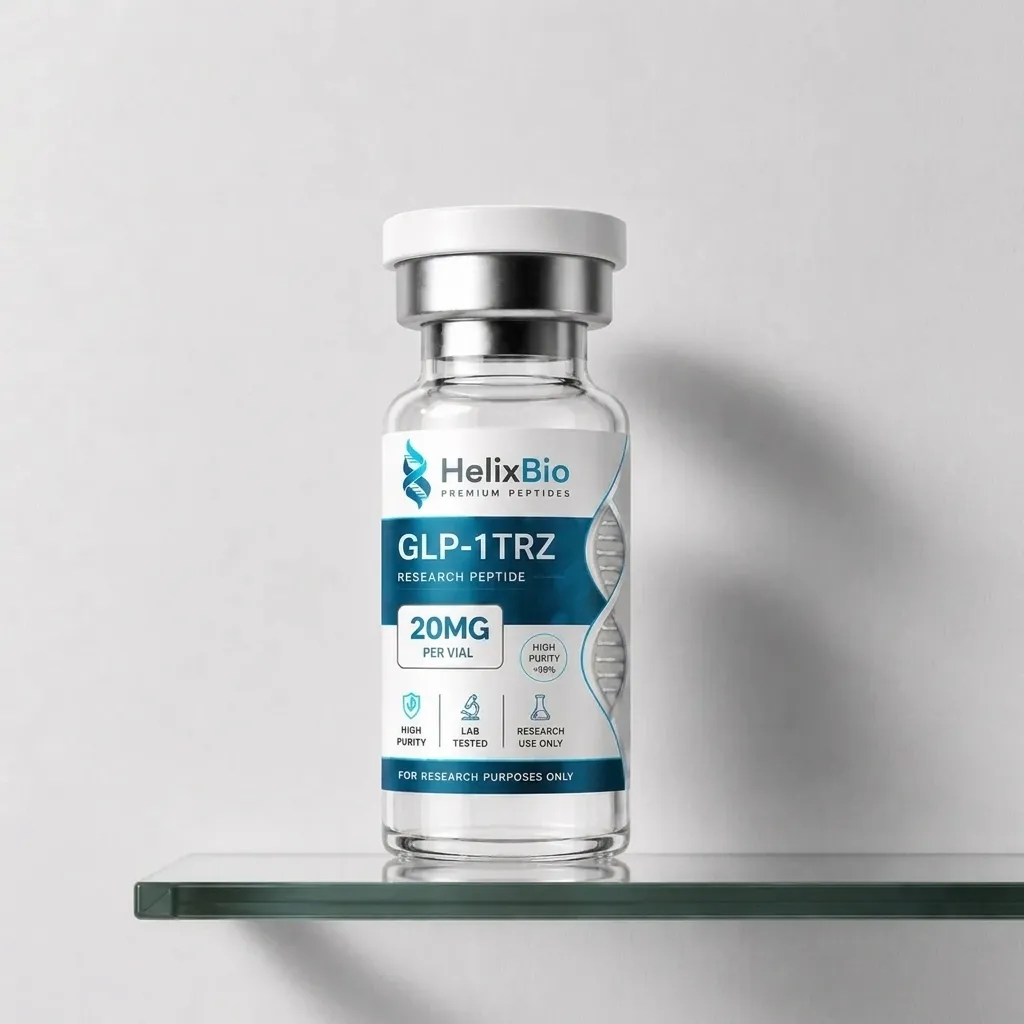
GLP-1TRZ
RESEARCH PEPTIDE
GLP-1TRZ is a synthetic research peptide studied for its activity as a dual GIP/GLP-1 receptor agonist — engaging two distinct incretin receptor pathways within a single molecule. It sits between single-receptor compounds like Semaglutide and the newer triple-agonist GLP-3RTA, making it a common middle point of comparison in incretin research. Helix Bio supplies GLP-1TRZ as a lyophilized powder intended strictly for laboratory and preclinical research, manufactured to a high-purity standard and backed by third-party verification. It is not intended for human consumption, diagnostic use, or any therapeutic application, and it is a separate product from FDA-approved branded medications.
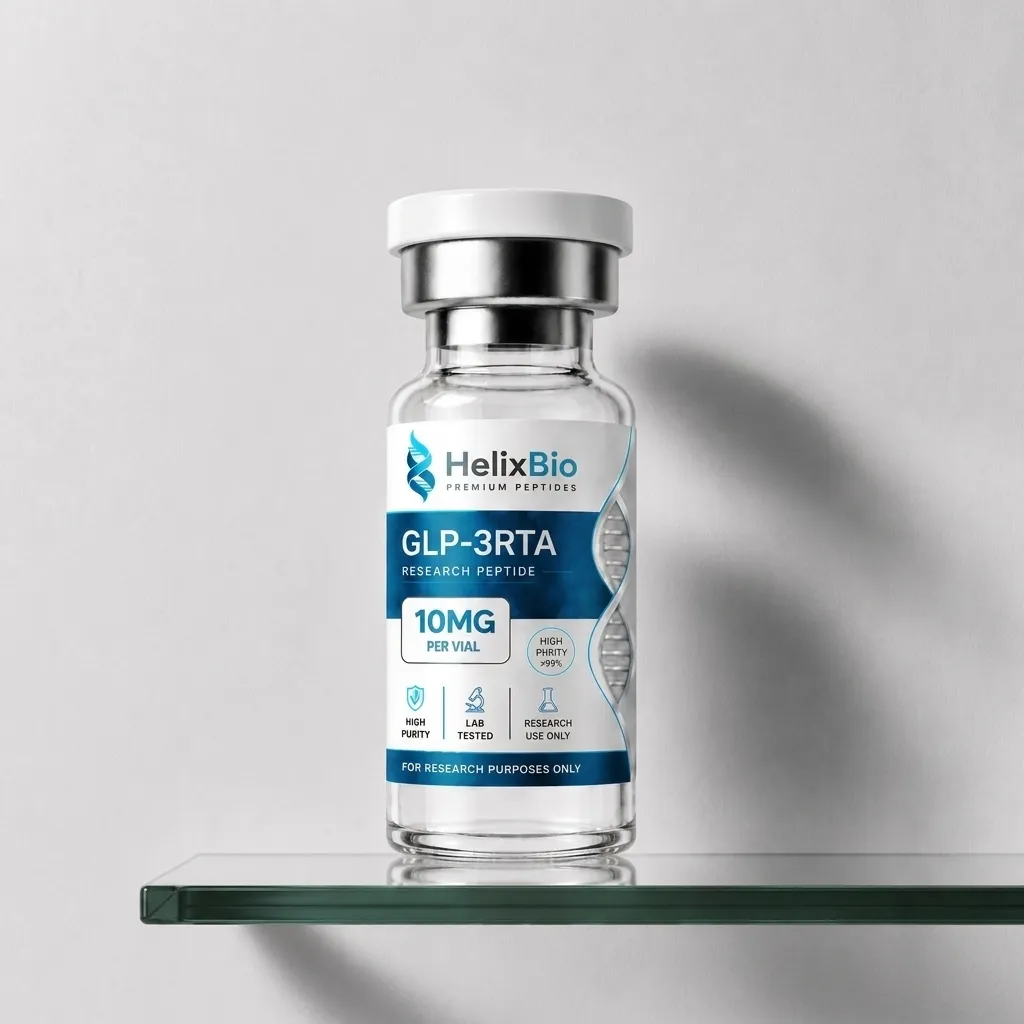
GLP-3RTA
RESEARCH PEPTIDE
GLP-3RTA is a synthetic research peptide studied for triple hormone receptor agonism — activity across the GLP-1, GIP, and glucagon receptors within a single molecule. That three-receptor mechanism has made it one of the most closely watched areas of metabolic and endocrine research, setting it apart from single- or dual-agonist peptides such as Semaglutide and GLP-1TRZ. Helix Bio supplies GLP-3RTA as a lyophilized powder intended strictly for laboratory and preclinical research, manufactured to a high-purity standard and backed by third-party verification. It is not intended for human consumption, diagnostic use, or any therapeutic application.
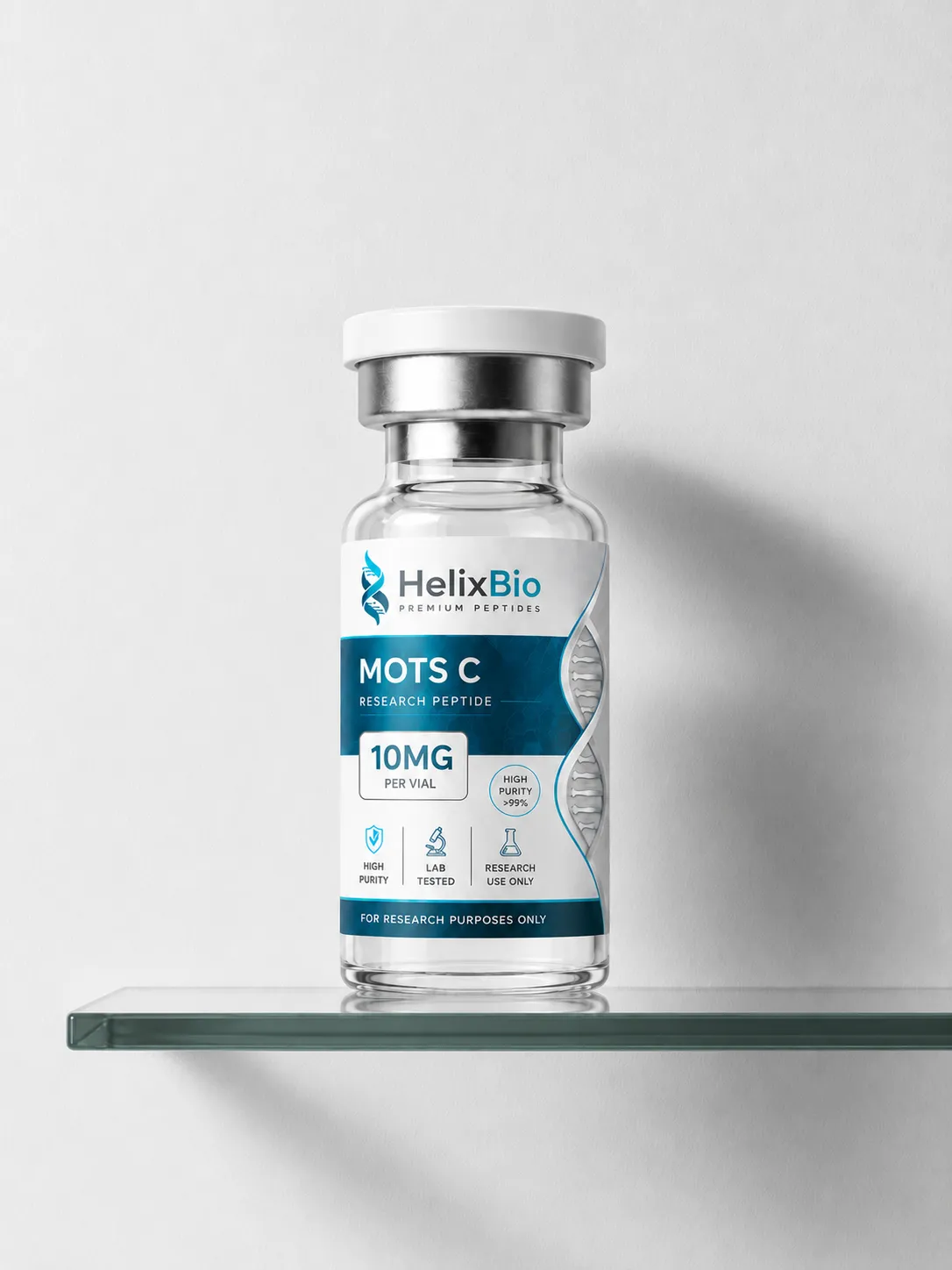
MOTS-C
RESEARCH PEPTIDE
MOTS-C is a mitochondrial-derived peptide (MDP) made up of 16 amino acids and encoded within a short open reading frame of the mitochondrial genome, rather than nuclear DNA. Since its identification, it has become one of the more closely studied peptides in mitochondrial biology, largely because it appears to act as a signaling molecule between mitochondria and the rest of the cell. Helix Bio supplies MOTS-C as a lyophilized research peptide, manufactured to a purity standard of 99% or higher and tested in-house before every batch ships. It is sold exclusively for laboratory research use by qualified professionals — not for human or animal use, and not for human consumption.
Everything below is framed for laboratory and in-vitro research contexts only. No compound named here is approved for human use, and nothing in this article should be read as a protocol, dosing guidance, or a therapeutic claim.
How Is AI Changing Peptide Discovery in 2026?
AI is changing peptide discovery by replacing random search with directed generation. Deep learning models now design peptide sequences from a specified target structure, predict how those sequences will fold and bind, and rank them before synthesis. The result is fewer synthesized candidates per validated hit and a shorter path from target selection to laboratory testing.
Three shifts define the current state of the field:
- Generation replaced screening as the starting point. Instead of testing an existing library, researchers generate sequences that do not exist in nature.
- Prediction absorbed early-stage filtering. Structure and affinity prediction now eliminate most candidates in silico, before synthesis costs are incurred.
- Validation became the bottleneck. Design capacity has outrun the ability of laboratories to synthesize, purify, and test what the models produce.
What Is AI Peptide Discovery?
AI peptide discovery is the use of machine learning models — primarily diffusion models, protein language models, and structure prediction networks — to design, evaluate, and prioritize peptide sequences computationally before laboratory synthesis. It covers both the invention of new sequences and the prediction of how existing ones fold, bind, and degrade.
What Is De Novo Peptide Design?
De novo peptide design is the computational creation of a peptide sequence that has no natural template. Rather than modifying a known peptide, the model is given a target — often a binding pocket on a receptor — and generates a backbone conformation that complements it, after which a sequence design model assigns the amino acids most likely to fold into that shape.
Structure Prediction vs. De Novo Design
Structure prediction answers a backward-looking question: given this amino acid sequence, what tertiary structure will it adopt? De novo design answers a forward-looking one: given this target, what sequence should exist?
The two are used together. A diffusion model proposes a backbone, an inverse folding model writes the sequence, and a structure prediction model is then run in reverse as a check — if the predicted structure of the designed sequence matches the intended backbone at low RMSD, the design advances. In short: prediction validates what design invents.
Why Are Peptides Well Suited to AI Design?
Peptides sit in a favorable position for computational design compared with both small molecules and full-size proteins:
- Short sequences mean a search space that models can cover meaningfully.
- Binding is dominated by a small number of interface residues, which models handle well.
- Solid-phase peptide synthesis (SPPS) makes designed sequences fast and cheap to produce.
- Structure–function relationships are more tractable than in large multi-domain proteins.
- Modifications such as cyclization and non-natural amino acids can be specified computationally.
- Failed designs are inexpensive to discard, which suits an iterative model-driven workflow.
The AI Peptide Design Tool Stack
Most 2026 peptide design work runs on a small set of models, several of which are open source:
- AlphaFold 2 / AlphaFold 3 — structure prediction, including protein–peptide and biomolecular interactions.
- RFdiffusion — diffusion-based generation of novel protein and peptide binder backbones.
- RFdiffusion2 / RFdiffusion3 — successor models from the Baker Lab, with RFdiffusion3 operating at the atom level.
- ProteinMPNN — inverse folding; assigns sequences to a given backbone.
- BindCraft — an automated binder design pipeline built around AlphaFold confidence metrics.
- ESM protein language models — sequence-level embeddings, property and stability prediction.
- Boltz, Chai and OpenFold — open structure prediction models used as independent cross-checks.
How Do the Main Design Tools Differ?
Tool | Function | Input → Output | Best for |
|---|---|---|---|
AlphaFold 3 | Structure prediction | Sequence(s) → predicted complex structure | Checking whether a designed peptide folds and docks as intended |
RFdiffusion | Backbone generation | Target structure → novel backbone | Creating new binder scaffolds against a defined pocket |
ProteinMPNN | Inverse folding | Backbone → amino acid sequence | Turning a generated shape into a synthesizable sequence |
BindCraft | End-to-end binder pipeline | Target → filtered binder candidates | Reducing candidate count before synthesis |
What Is Inverse Folding?
Inverse folding is the task of finding an amino acid sequence that will fold into a given three-dimensional structure. It is the reverse of structure prediction. ProteinMPNN, published in Science in 2022, is the model most widely used for this step in peptide and protein design pipelines.
What Is a Protein Language Model?
A protein language model is a transformer trained on tens of millions of protein sequences, learning statistical patterns of residue co-occurrence in much the way a text model learns language. Meta's ESM family is the best-known example. These models produce embeddings used to predict stability, solubility, and functional constraints without any structural input.
What Changed in Peptide Discovery Between 2023 and 2026
Year | Milestone |
|---|---|
2021 | AlphaFold 2 published in Nature; accurate structure prediction becomes broadly available |
2022 | ProteinMPNN published in Science, establishing deep-learning inverse folding |
2023 | RFdiffusion published in Nature; de novo binder design becomes practical |
2024 | AlphaFold 3 extends prediction to protein–ligand and protein–peptide complexes |
2024 | David Baker shares the Nobel Prize in Chemistry for computational protein design |
2024 | BindCraft released as a preprint, reporting sharply higher one-shot binder success rates |
2025 | Rentosertib, an AI-discovered small molecule, reports Phase IIa results in Nature Medicine |
2025 | RFdiffusion3 released open source by the Baker Lab, designing at atom-level resolution |
2026 | RFdiffusion2 published in Nature Methods; atom-level enzyme active-site scaffolding |
The through-line is that design quality improved faster than validation throughput. That imbalance defines the practical reality of peptide research in 2026.
The AI Peptide Design Workflow, Step by Step
- Define the target. Select the receptor, epitope, or binding pocket and obtain a structure from the Protein Data Bank or the AlphaFold Protein Structure Database.
- Generate backbones. Run a diffusion model against the target to produce candidate binder conformations.
- Design sequences. Apply an inverse folding model to assign residues to each backbone.
- Predict and filter. Re-fold every designed sequence with a structure prediction model and discard designs that miss the intended conformation.
- Score for developability. Screen computationally for solubility, aggregation risk, protease-susceptible motifs, and synthesizability.
- Synthesize the survivors. Produce the shortlist by SPPS and verify identity and purity by HPLC and LC-MS.
- Test experimentally. Measure binding, stability, and functional activity in the appropriate in-vitro assay, then feed results back into the next design round.
AI-Driven Design vs. Traditional Library Screening
Dimension | Traditional screening | AI-driven design |
|---|---|---|
Starting point | An existing library of sequences | A target structure and design objective |
Search strategy | Broad empirical testing | Directed generation and computational filtering |
Candidates synthesized | Thousands to millions | Tens to low hundreds |
Main cost centre | Wet-lab throughput and reagents | Compute, plus focused validation |
Novelty ceiling | Limited to library diversity | Sequences with no natural counterpart |
Primary failure mode | Missing what the library never contained | Confident predictions that do not hold experimentally |
The verdict is not that one replaces the other. Computational design narrows the field; empirical work still decides.
Where AI Is Being Applied in Peptide Research
Metabolic and GLP-1 Research
Incretin-class peptides are among the most computationally modelled targets in the field, because receptor structures are well characterized and the sequence space around known agonists is dense with published data. Comparative work on GLP-1 and GIP receptor agonist research increasingly draws on predicted receptor–ligand models alongside published in-vitro data.
Antimicrobial Peptide Discovery
Antimicrobial peptides are a natural fit for machine learning classification: large labelled datasets exist, activity is sequence-driven, and candidate generation is cheap. Published work in this area routinely reports models proposing thousands of candidate sequences, with only a small validated subset advancing to laboratory assay.
Stability, Protease Resistance and Half-Life
A significant share of applied AI work is not about inventing new sequences at all — it is about making known ones behave better. Models are used to flag protease-cleavable motifs, predict aggregation propensity, and suggest cyclization or substitution strategies. These predictions still have to be confirmed empirically, which is why reconstitution and stability handling remains a controlled variable in any comparative study.
Tissue Repair and Longevity Research Targets
Structural modelling is also applied to shorter signalling peptides studied in tissue repair research and in cellular energy and longevity research, though short and intrinsically disordered sequences remain among the hardest cases for structure prediction.
What Are the Limitations of AI in Peptide Discovery?
- Training data is skewed toward crystallizable, well-behaved structures.
- Confidence scores measure model certainty, not experimental truth.
- Intrinsically disordered and highly flexible peptides predict poorly.
- Designed sequences are often difficult or expensive to synthesize.
- Binding affinity prediction remains substantially weaker than structure prediction.
Why Do AI-Designed Peptides Still Fail in the Lab?
Most failures are not errors of shape but of context. A model can produce a sequence that folds exactly as predicted and still see it aggregate at working concentration, degrade in the assay buffer, bind a related off-target receptor, or resist clean synthesis. Prediction operates on an idealized single molecule; the laboratory operates on a population in solution.
No AI-designed peptide has been approved by the FDA for human therapeutic use. Compounds discussed in this article are research chemicals intended for laboratory investigation only. See the [medical disclaimer](/medical-disclaimer) for full terms.
Are AI-Designed Peptides in Clinical Trials Yet?
AI-discovered compounds have entered clinical trials, but none has reached approval. The most cited example is rentosertib (ISM001-055), a TNIK inhibitor discovered and designed using Insilico Medicine's generative platform, whose Phase IIa results in idiopathic pulmonary fibrosis were published in Nature Medicine in June 2025. It is a small molecule rather than a peptide, and it remains investigational.
For peptide and miniprotein binders specifically, the published record in 2026 is still dominated by preclinical and in-vitro validation. Design capability is well ahead of clinical evidence, and that gap should be stated plainly in any research write-up that cites computational origin as a credential.
How AI Is Changing Research Peptide Sourcing and Quality
The practical consequence for laboratories is that novel and near-novel sequences are entering circulation faster than reference standards for them exist. When a sequence is new, there is no long tail of published characterization to compare against — which raises the weight carried by supplier documentation.
Three checks matter more for novel sequences than for well-established compounds:
- Identity confirmation by mass spectrometry, not purity alone — a clean HPLC trace on the wrong molecule is still the wrong molecule.
- A batch-specific certificate of analysis, matched by lot number to the vial in hand. Reading one properly is covered in the guide to reading a certificate of analysis.
- Documented storage and cold-chain handling, since novel sequences frequently have unknown degradation profiles and unrecognized storage-related potency loss can silently invalidate results.
Treat a supplier's batch documentation as experimental metadata, not paperwork. Record lot number, stated purity, analytical method, and reconstitution date alongside your results — reproducibility in AI-guided work depends on it. A structured [sourcing checklist](/how-to-buy-research-peptides-online-usa-checklist) makes this consistent across studies.
Research Use Only: What It Means for AI-Designed Compounds
The regulatory position does not change because a sequence came from a model. In the United States, research peptides are supplied strictly for laboratory investigation, are not FDA-approved, and are not intended for human or veterinary use. Computational novelty carries no regulatory weight, and a design pedigree is not evidence of safety — the details are set out in the guide to research use only compliance.
For laboratories running comparative in-vitro work, the practical takeaway is unchanged: verify identity, document the batch, control storage, and treat computational predictions as hypotheses to be tested. Helix Bio supplies research-grade peptides with batch-specific analytical documentation for exactly that kind of work, and the peptide calculator supports accurate reconstitution record-keeping.
Last updated: August 26, 2026.
Frequently Asked Questions
AI peptide discovery is the use of machine learning models to design, predict, and prioritize peptide sequences computationally before laboratory synthesis. It combines generative models that invent new sequences with structure prediction models that verify how those sequences fold and bind to a target.
Three shifts define 2026: generative design replaced library screening as the starting point, computational prediction absorbed most early-stage filtering, and laboratory validation became the rate-limiting step. Researchers now synthesize far fewer candidates per confirmed hit than in library-based workflows.
No. Researchers define the target, choose the models, set the design constraints, and decide which predictions merit synthesis. The models generate and rank candidates; humans specify the objective and interpret every experimental result that follows.
AlphaFold predicts the three-dimensional structure a sequence will adopt. In peptide work it is used to check whether a designed sequence folds into the intended conformation and, with AlphaFold 3, to model protein-peptide and other biomolecular complexes.
RFdiffusion is a diffusion-based generative model from the Baker Lab at the University of Washington that designs novel protein and peptide backbones against a specified target. It was published in Nature in 2023, with successor models RFdiffusion2 and RFdiffusion3 released since.
Some computationally derived sequences are offered by suppliers as research chemicals for laboratory investigation only. They are not approved for human use, and availability as a research-use-only compound carries no regulatory or safety endorsement.
No. As of 2026 no AI-designed peptide has received FDA approval. Several AI-discovered compounds are in clinical development, but investigational status is not approval and should always be described as such in research write-ups.
Yes. Rentosertib (ISM001-055), a TNIK inhibitor discovered using Insilico Medicine's generative platform, reported Phase IIa results in Nature Medicine in June 2025. It is a small molecule rather than a peptide, and it remains investigational.
Accuracy is high for well-folded, structured sequences resembling training data and considerably lower for short, flexible, or intrinsically disordered peptides. Model confidence scores indicate certainty about the prediction, not experimental correctness.
Partially. Current models rank candidates by predicted affinity reasonably well but predict absolute binding constants poorly. Affinity prediction remains the weakest link in the computational pipeline and is routinely confirmed by in-vitro binding assays.
Yes. Prediction models operate on idealized single molecules, while experiments involve populations in solution subject to aggregation, degradation, and off-target binding. Every computational design is treated as a hypothesis until confirmed by synthesis, analytical verification, and assay.
Four recur most often: training data skewed toward crystallizable structures, weak affinity prediction, poor performance on disordered sequences, and a synthesizability gap between what a model proposes and what a laboratory can practically produce.
Synthesis chemistry is largely unchanged; solid-phase peptide synthesis still produces the material. What changes is throughput pressure and sequence novelty, as suppliers are asked for shorter runs of unusual sequences with no established characterization history.
It raises their importance. Novel sequences lack published reference data, so identity confirmation by mass spectrometry and a batch-specific certificate of analysis carry more weight than with well-characterized compounds where comparison points are abundant.
Research use only (RUO) means a compound is supplied strictly for laboratory investigation, is not FDA-approved, and is not intended for human or veterinary use. The designation applies identically to computationally designed and naturally derived sequences.
- 01Jumper J, et al. Highly accurate protein structure prediction with AlphaFold. Nature, 2021. doi:10.1038/s41586-021-03819-2
- 02Abramson J, et al. Accurate structure prediction of biomolecular interactions with AlphaFold 3. Nature, 2024. doi:10.1038/s41586-024-07487-w
- 03Watson JL, et al. De novo design of protein structure and function with RFdiffusion. Nature, 2023. doi:10.1038/s41586-023-06415-8
- 04Dauparas J, et al. Robust deep learning-based protein sequence design using ProteinMPNN. Science, 2022. doi:10.1126/science.add2187
- 05Ahern W, et al. Atom-level enzyme active site scaffolding using RFdiffusion2. Nature Methods, 2026. doi:10.1038/s41592-025-02975-x
- 06Baker Lab, Institute for Protein Design, University of Washington - publications index for RFdiffusion, RFdiffusion2 and RFdiffusion3
- 07Insilico Medicine. Nature Medicine publication of Phase IIa results for rentosertib (ISM001-055), June 2025.
- 08AlphaFold Protein Structure Database, EMBL-EBI and Google DeepMind
Helix Bio Chem Team
Research & Product Team
Our in-house team tracks published peptide research and translates it into clear, source-cited summaries for the research community.
Reviewed by in-house research chemists
support@helixbiochem.com