- PT-141 and bremelanotide are the same molecule, registered by the FDA under UNII 6Y24O4F92S with CAS number 189691-06-3.
- The FDA label describes bremelanotide as a non-selective melanocortin receptor agonist, with potency ordered MC1R, MC4R, MC3R, MC5R, MC2R. The widely repeated MC4R-selective claim contradicts that label.
- Bremelanotide holds one FDA approval, as Vyleesi under NDA 210557 since 21 June 2019, for acquired generalized HSDD in premenopausal women only.
- The approved label states that the mechanism by which Vyleesi improves HSDD is unknown.
- Across two Phase 3 trials in 1,267 women, the integrated difference versus placebo was +0.35 on the FSFI desire domain. The difference on FSDS-DAO question 13 was -0.33, and satisfying sexual events showed no significant difference.
- In the pooled Phase 3 safety population, nausea affected 40.0% on drug against 1.3% on placebo. Discontinuation for adverse reactions ran at 18% against 2%.
- Focal hyperpigmentation is a labelled adverse reaction, reported in 1% of patients at up to eight doses per month. A separate study found it in 38% of participants after eight days of daily dosing.
- Bremelanotide appears on no FDA 503A or 503B bulk substance category list, and on no PCAC agenda checked. It is not named on the 2026 WADA Prohibited List or Monitoring Program.
PT-141 is bremelanotide, a synthetic cyclic heptapeptide that activates melanocortin receptors. The FDA approved it once, as Vyleesi, for low sexual desire in premenopausal women. Its label calls it non-selective, not MC4R-selective, and says the mechanism behind the benefit is unknown. Research-grade PT-141 is not Vyleesi.
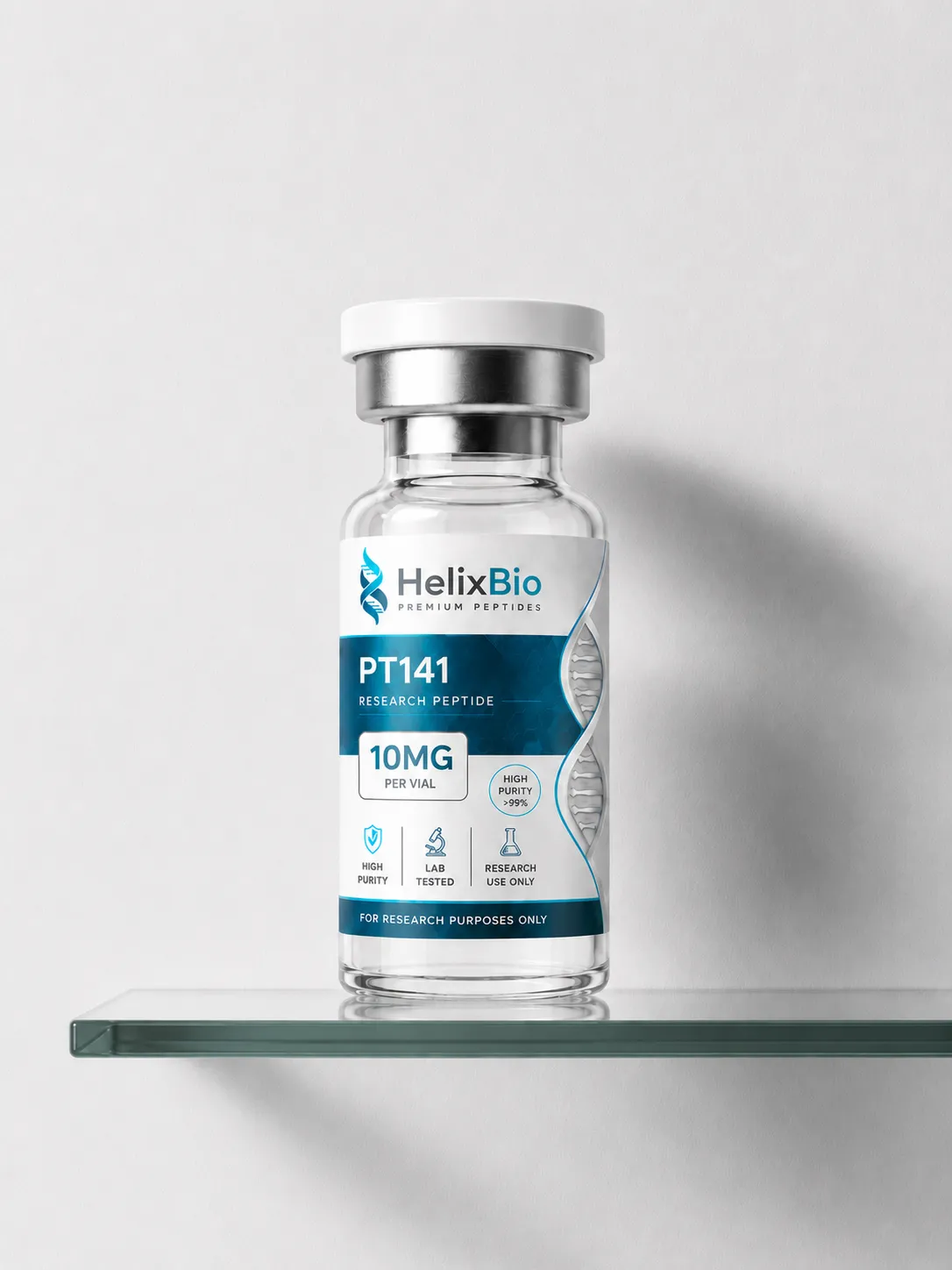
PT-141
RESEARCH PEPTIDE
PT-141, also known as bremelanotide, is a synthetic cyclic peptide analog of alpha-melanocyte-stimulating hormone (α-MSH) used in research involving melanocortin receptor biology, peptide-receptor interactions, and cellular signaling. The compound has been investigated across melanocortin receptor subtypes, including MC1R, MC3R, MC4R, and MC5R. Helix Bio supplies PT-141 as a research-use-only peptide for qualified laboratory and scientific applications. Researchers should review the current lot-specific Certificate of Analysis (COA), analytical documentation, and product specifications before incorporating the material into an experimental workflow.
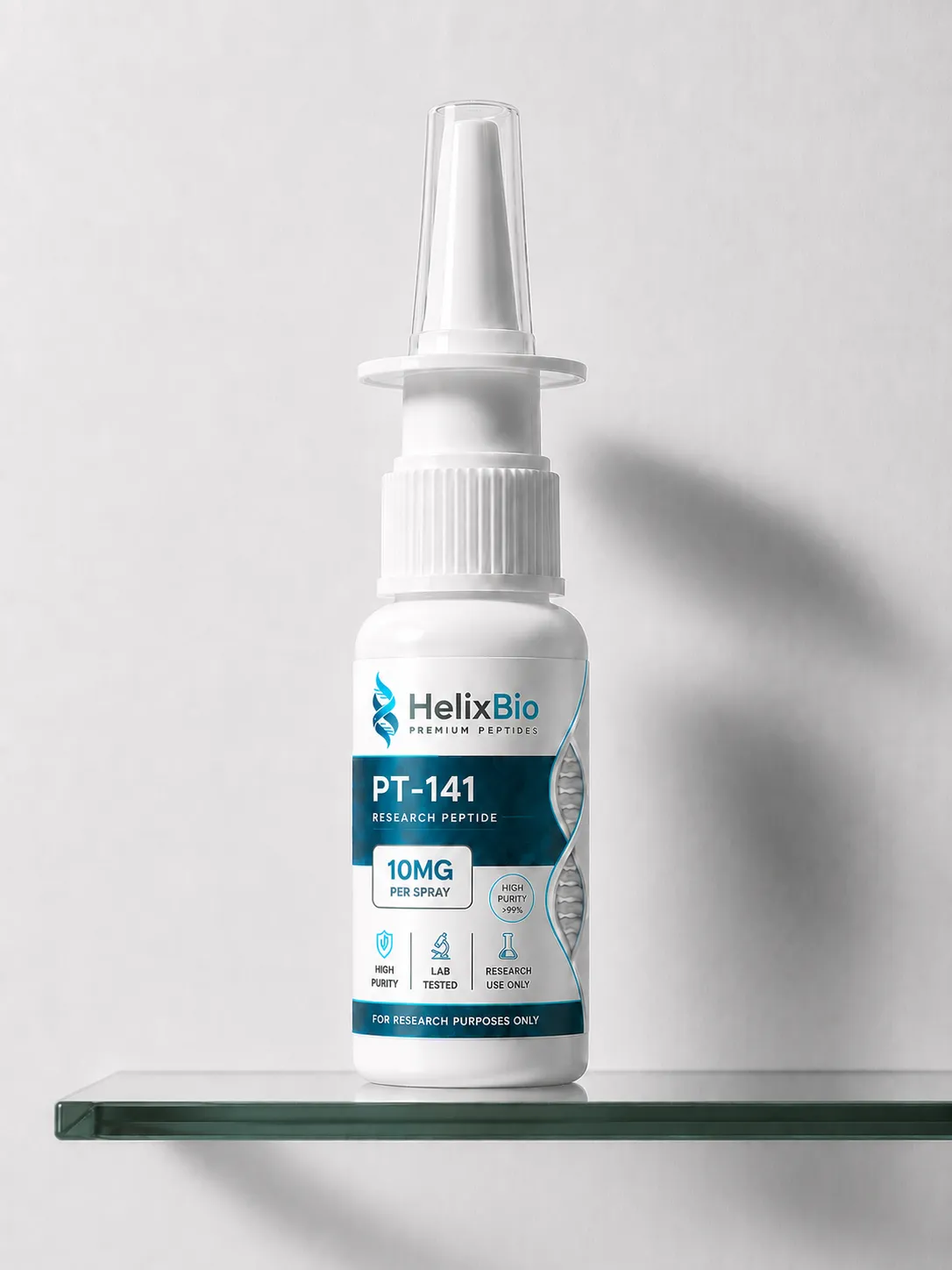
PT-141 Spray
RESEARCH PEPTIDE
PT-141 Spray is a research-use-only preparation featuring PT-141, also known as bremelanotide, a synthetic cyclic peptide analog related to alpha-melanocyte-stimulating hormone (α-MSH). PT-141 is studied extensively in melanocortin receptor biology, peptide-receptor interactions, neurobiology, and cellular signaling. Helix Bio provides research materials for controlled laboratory and scientific applications. This spray-format product is intended exclusively for research and laboratory use and is not intended for human or veterinary administration.
What the evidence supports, at a glance
Question | Strongest evidence available | What that evidence supports |
|---|---|---|
Does bremelanotide raise sexual desire in premenopausal women with HSDD? | Two Phase 3 randomized, placebo-controlled trials, 1,267 women | Randomized controlled trials found a small average gain on both co-primary scores, +0.35 on desire and -0.33 on distress |
Is PT-141 FDA approved? | Regulatory record, NDA 210557 | Yes, as the branded product Vyleesi, for acquired generalized HSDD in premenopausal women only |
Is the mechanism behind that benefit known? | Approved product label, section 12.1 | No. The label states that the mechanism by which Vyleesi improves HSDD is unknown |
Does bremelanotide treat erectile dysfunction? | Small early-phase trials, the largest male study now under an Expression of Concern | Current evidence does not establish an effect in men, and the label is not indicated in men |
Does PT-141 cause weight loss or tanning? | Two Phase 1 trials for weight, label safety sections for pigmentation | Current evidence does not establish either as a benefit. Focal skin darkening appears on the label as a harm |
PT-141 identity, every field from a primary source
No competing page publishes the whole identity block in one place. The table below carries the full set.
Field | Value | Primary source |
|---|---|---|
Names | PT-141, bremelanotide (INN and USAN), PT-141 free base, brand name Vyleesi | FDA Substance Registration System, record 6Y24O4F92S |
Sequence | Ac-Nle-cyclo(Asp-His-D-Phe-Arg-Trp-Lys-OH) | DailyMed, Vyleesi label section 11 |
Class and ring | Synthetic cyclic heptapeptide. The ring is a side-chain lactam between Asp2 and Lys7. The N-terminus stays acetylated and the C-terminus is a free acid | DailyMed section 11, PubChem systematic name |
Molecular formula, free base | C50H68N14O10 | DailyMed section 11, FDA SRS |
Molecular weight, free base | 1025.2 average. The FDA SRS record computes 1025.1647 | DailyMed section 11, FDA SRS |
CAS number, free base | 189691-06-3 | FDA SRS |
UNII | 6Y24O4F92S for the free base. The acetate carries a different UNII, PV2WI7495P | FDA SRS |
PubChem CID | 9941379 | FDA SRS code list |
InChIKey | FFHBJDQSGDNCIV-MFVUMRCOSA-N | FDA SRS |
Other registry codes | ChEMBL CHEMBL2070241, DrugBank DB11653, MeSH C476721, RxCUI 2176312, NCI Thesaurus C77009, INN 8737 | FDA SRS |
Salt equivalence | 1.75 mg bremelanotide equals 1.89 mg bremelanotide acetate | DailyMed section 11 |
Approved product | Vyleesi autoinjector, NDA 210557, approved 21 June 2019 | Drugs@FDA |
Four identifiers circulate on vendor and SEO pages and none of them belongs to this compound. CAS 189722-12-9 is not the registry number for bremelanotide. UNII 6Y24O4F37N is a transcription slip. CAS 1607799-13-2 identifies the acetate salt, so it should never stand in for the free base. The claim that PT-141 lacks an N-terminal acetyl group is also wrong, because the label describes an acetylated amino terminus.
What PT-141 is
PT-141 and bremelanotide name the same molecule. Vendors tend to use the research code. Regulators and journals use the generic name. The brand name Vyleesi refers to one approved product that contains it. Some suppliers list the material as PT-141 acetate, which is the salt form the approved injection also uses.
Chemists would call it a cyclic heptapeptide. Seven amino acids sit in a ring closed by a bond between the side chains of aspartate at position two and lysine at position seven. Inside that ring sits the His-D-Phe-Arg-Trp motif that melanocortin receptors recognise. The D-form phenylalanine matters, because swapping one amino acid to its mirror image slows enzymatic breakdown.
The compound came out of melanocortin work in the 1990s and shares its core with Melanotan II. One structural difference separates them, and the two compounds went in very different directions afterwards. That difference gets its own section below, and the full side-by-side comparison lives in the PT-141 vs Melanotan II receptor research article.
How PT-141 works
The label says non-selective, and that correction matters
Search results are full of a claim that PT-141 selectively activates MC4R, roughly 25 times more than MC1R, and therefore cannot affect skin pigment. The approved label says something different. Section 12.1 describes bremelanotide as a melanocortin receptor agonist that nonselectively activates several subtypes. The order of potency runs MC1R, then MC4R, then MC3R, then MC5R, then MC2R. Binding at MC1R and MC4R is the most relevant at therapeutic dose levels, the label adds.
The first receptor on that list is the pigment receptor. Any page describing PT-141 as MC4R-selective is arguing with the only human-approved document that exists for this molecule.
Why this page carries no receptor affinity table
Numbers for binding affinity and potency do exist in the literature. The published values do not agree with each other. Published MC4R values range across roughly a tenfold spread. MC5R values vary across roughly a hundredfold spread between compilations. Assays, cell lines, radioligands and endpoints all differ between labs. The FDA label gives a rank order and no numbers at all. This page follows the label, and treats any single nanomolar table on this compound as unverified.
Where the receptors sit, and what happens after binding
MC4R appears widely in the central nervous system, which is the pharmacological reason this compound gets studied for desire instead of for blood flow. MC1R sits on melanocytes, and the label states plainly that binding there leads to melanin expression and increased pigmentation.
Downstream signalling is where careful sourcing matters most. Melanocortin-4 receptors couple to Gs and raise intracellular cAMP, which an open-access review of MC4R signalling describes as the canonical pathway. That same review notes the receptor can also recruit Gi/o, Gq/11 and G12/13 proteins and arrestins, so a single-pathway story oversimplifies it. Structural biology closes the loop on the ligand itself. Cryo-electron microscopy structures published in 2021 captured full-length MC4R bound to agonists including bremelanotide, in complex with heterotrimeric Gs protein.
None of that appears on the FDA label, so the attribution here goes to the structural and review literature.
The honest part most pages bury
The label states that the mechanism by which Vyleesi improves HSDD is unknown. Receptor binding at those subtypes is established. Human structural engagement with Gs is established. The causal chain from a melanocortin receptor to reported desire is not.
Human evidence versus animal evidence
Animal studies reported behaviour that looks suggestive and proves nothing about people. In oestrogen-primed female rats, PT-141 selectively increased solicitation behaviours without changing lordosis, pacing or other sexual behaviours, and without generalised motor activation. Early work also reported erections in rats and in non-human primates, which is why the compound entered male trials first. Rodent behaviour is not a human mechanism, and the peptide research evidence grading methodology explains why that inference does not carry.
One position apart from Melanotan II
Field | PT-141 (bremelanotide) | Melanotan II |
|---|---|---|
C-terminus | Free acid, written -OH | Amide, written -NH2 |
Molecular formula | C50H68N14O10 | C50H69N15O9 |
Molecular weight | 1025.2 | 1024.2 |
CAS number | 189691-06-3 | 121062-08-6 |
UNII, FDA substance record | 6Y24O4F92S | UPF5CJ93X7 |
Both compounds share the same seven-residue ring and the same Asp-Lys lactam bridge. They differ at the carboxyl end, where PT-141 carries a free acid and Melanotan II carries an amide. PT-141 is the deamidated metabolite of Melanotan II, which is a different thing from a de-acetylated product; the acetyl group stays put in both.
That single change did not remove pigment activity. MC1R still sits first in the potency order, and skin darkening still appears in the approved label as an adverse reaction. So PT-141 is not a tanning compound, and it is not pigment-free either. The receptor-level argument is set out in the comparison article and in Melanotan 1 vs Melanotan 2 receptor data.
Is PT-141 FDA approved, and how Vyleesi differs from a research vial
Bremelanotide holds exactly one regulatory approval. The FDA approved Vyleesi on 21 June 2019 under NDA 210557, as a new molecular entity. Its indication is acquired, generalized hypoactive sexual desire disorder in premenopausal women. Palatin Technologies developed the molecule and AMAG Pharmaceuticals held the application at approval. Drugs@FDA now lists Cosette Pharmaceuticals as the company, and the most recent labelling supplement was approved on 22 October 2026.
The label's limits of use are as specific as the indication. Vyleesi is not indicated for HSDD in postmenopausal women, it is not indicated in men, and it is not indicated to enhance sexual performance.
The label's own limits, reported as regulation and not as instruction
Vyleesi's approved regimen is 1.75 mg given subcutaneously by autoinjector, as needed, at least 45 minutes before anticipated sexual activity. No more than one dose in 24 hours. More than eight doses per month is not recommended, and prescribers are told to stop after eight weeks without improvement. Mean terminal half-life is roughly 2.7 hours, with a range of 1.9 to 4.0 hours.
Those figures are regulatory facts about an approved prescription product. They are not a protocol, and nothing on this page is an administration instruction for any purpose.
The three-way distinction
Research vial | Research spray | Vyleesi autoinjector | |
|---|---|---|---|
Molecule | Bremelanotide | Bremelanotide | Bremelanotide acetate |
Regulatory status | No FDA review of the product | No FDA review of the product | Approved under NDA 210557 |
Manufacturing oversight | Supplier quality system, verified lot by lot through documentation | Supplier quality system, verified lot by lot through documentation | FDA-reviewed manufacturing and specifications |
Stated contents | Nominal peptide mass, confirmed by the lot COA | Nominal peptide mass, confirmed by the lot COA | 1.75 mg bremelanotide in 0.3 mL, label-specified |
Intended use | Laboratory research only | Laboratory research only | Prescription treatment within the approved indication |
Sterility and endotoxin | Not established by a purity figure | Not established by a purity figure | Established under the approved application |
The active molecule is the same, and the product is not. That distinction is doing legal work, not just editorial work. The FDA issued five warning letters dated 24 August 2026, posted on 1 September. Each one named PT-141 among the products at issue. Every letter treated the seller's own website copy as evidence of intended human use, and rejected research-use-only labelling as a defence.
The September 2026 FDA peptide crackdown explainer covers that enforcement batch in detail. The wider legal position sits in are research peptides legal in the USA.
The letters established marketing and intended-use violations. They were not a ban, a recall, a seizure or a product-testing finding, and Vyleesi remains approved throughout.
What the RECONNECT trials actually showed
Design
Two identically designed Phase 3 trials carried the approval, registered as NCT02333071 and NCT02338960. Kingsberg and colleagues published them together in Obstetrics and Gynecology in 2019. Both were randomized, double-blind, placebo-controlled and multicentre. In total 1,267 premenopausal women with acquired, generalized HSDD were randomized, 1,247 entered the safety population and 1,202 entered the modified intent-to-treat analysis. Treatment ran for 24 weeks at 1.75 mg as needed, with an optional 52-week open-label extension afterwards.
The co-primary endpoints were change scores, not responder rates
Vendor pages and news write-ups misreport this constantly. The two co-primary endpoints were both change-from-baseline scores at end of study. One was the FSFI desire domain score. The other was FSDS-DAO question 13, which asks how bothered the participant felt by low desire. Both the paper and label section 14 state it the same way.
Integrated results gave a difference versus placebo of +0.35 on the desire domain and -0.33 on the distress item. Both p-values sat below .001 in that analysis. Individual trials gave +0.30 and +0.42 on desire, and -0.37 and -0.29 on distress. Those are small movements on scales that run from 1.2 to 6.0 and from 0 to 4. Responder analyses do exist in the paper, and the label presents responder thresholds as supplementary analyses to help interpret clinical meaningfulness. Approval did not rest on them.
The endpoint that did not move
Satisfying sexual events was a key secondary endpoint, and it showed no significant difference between groups. Label section 14 reports p values of 0.76 in the first study and 0.70 in the second. A woman taking the drug reported more desire and less distress about desire, on average, without recording more satisfying events than placebo. Any page citing a "25% versus 9.8%" figure is quoting a post-hoc analysis of the proportion of encounters. That was not the endpoint the trials set out to measure.
The extension establishes less than it appears to
Of 856 women eligible after the core phase, 684 entered the 52-week open-label extension and 272 completed it. Drug-related adverse events in the extension ran at 40.4% for nausea, 20.6% for flushing and 12.0% for headache. The authors reported no new safety signals and sustained improvement, and they also stated that all analyses were descriptive. An uncontrolled extension that only enrolled core-phase completers cannot establish long-term safety, and the attrition between 684 and 272 is the reason.
Independent reanalysis, cited to the right papers
Spielmans published a reanalysis in The Journal of Sex Research in 2021. It worked from the New Drug Application, the registry protocol entries and the published paper. The reanalysis reported that 8 of 11 protocol-listed efficacy outcomes went unreported. Fifteen secondary measures appeared in the trial report without sitting in any protocol. None of the efficacy outcomes met CONSORT reporting standards.
Its own meta-analysis of FDA data put the co-primary effect sizes at d+ = .35 for desire and d+ = .30 for distress. Discontinuation for adverse events was far more likely on drug, at an odds ratio of 11.98. Women on drug were also less likely to enter the open-label extension.
A second paper by Spielmans and Ellefson followed in 2024, in the same journal, titled "Small Effects, Questionable Outcomes". That one examined the measurement properties of the RECONNECT efficacy instruments.
Conflicts of interest are part of the record too. Four of the trial paper's authors worked for Palatin Technologies or AMAG Pharmaceuticals. The remaining authors reported financial relationships with one or both companies. The trial sponsor took part in design, execution, analysis and reporting.
What the evidence does not show
Nothing here establishes a mechanism for the benefit, a benefit in men, or a benefit after menopause. The trials also leave open any effect on satisfying sexual events, long-term safety beyond a year, and generalisability past the trial population. The label records the pooled population as 86% White and 12% Black, aged 19 to 56, with a mean age of 39.
Side effects and safety, with the placebo column
Label Table 1 pools 627 women on Vyleesi against 620 on placebo. The placebo column is what makes these numbers interpretable, and most competing pages leave it out.
Adverse reaction | Vyleesi | Placebo |
|---|---|---|
Nausea | 40.0% | 1.3% |
Flushing | 20.3% | 0.3% |
Injection site reactions | 13.2% | 8.4% |
Headache | 11.3% | 1.9% |
Vomiting | 4.8% | 0.2% |
Discontinuation because of adverse reactions ran at 18% on drug against 2% on placebo. Nausea is the single most-searched safety question on this compound, and the trial data explain why.
Blood pressure moves in a measurable and transient way. The label reports maximum increases of 6 mmHg systolic and 3 mmHg diastolic, peaking two to four hours after a dose. Heart rate falls by up to 5 beats per minute, and values usually return to baseline within 12 hours. Vyleesi is contraindicated in uncontrolled hypertension and in known cardiovascular disease.
Skin darkening deserves its own line. Focal hyperpigmentation was reported by 1% of patients receiving up to eight doses per month, against no placebo patients. In a separate study of daily dosing, 38% developed it after eight days, and a further 14% developed new changes over the next eight days. Resolution was not confirmed in every patient.
Two interaction warnings sit in label section 7, and neither comes with a number. Vyleesi may slow gastric emptying and reduce absorption of oral drugs. The label illustrates that with antibiotics needing threshold concentrations, and with pain relievers such as indomethacin. It may also significantly decrease exposure to oral naltrexone, so the label advises avoiding that combination. Any page quoting precise interaction percentages for this compound is quoting something the label does not contain.
PT-141 for women and for men
For premenopausal women with acquired, generalized HSDD, the evidence base is two Phase 3 trials and one approved indication. That is the strongest evidence any melanocortin compound has in sexual medicine, and the effect it supports is small.
In men, the picture is thinner than the marketing suggests. Zero Phase 3 trials in men exist, and the label is explicit that the product is not indicated in men. The largest male study enrolled 342 men who had not responded to sildenafil, dosing 10 mg of bremelanotide intranasally. Safarinejad and Hosseini published it in 2008.
A formal Expression of Concern followed on 10 January 2023, issued by The Journal of Urology. That was one of 14 expressions of concern the journal issued for the same author's work that day. Treating that trial as evidence means treating a flagged paper as evidence.
What remains in men is small early-2000s intranasal work at different routes and amounts. A company has also announced a Phase 2 programme pairing bremelanotide with a PDE5 inhibitor, and no published results have followed it. Current evidence does not establish efficacy or safety for erectile dysfunction, and no regulator has approved it for that use.
Injection, spray and troche
Route changes the pharmacology, and route-specific evidence does not transfer for free.
The approved product is a subcutaneous autoinjector, and every pharmacokinetic figure on the label belongs to that route. Intranasal bremelanotide was the original development path and it no longer is. The programme moved away from nasal delivery, and no nasal bremelanotide product holds approval anywhere. Troches appear in compounded listings without peer-reviewed pharmacokinetic data, which means absorption, exposure and duration for that format rest on nothing published.
Helix Bio Chem supplies both a PT-141 research vial and a PT-141 research spray, so the framing matters here. Subcutaneous trial data describe a subcutaneous product. They do not establish bioavailability, exposure or stability for a spray or a troche. Handling and storage questions for laboratory work are covered in the peptide reconstitution and storage guide. That guide stays at the level of laboratory practice and gives no administration guidance.
Compounding status and anti-doping status
Two regulatory questions get asked about this compound and almost nobody answers either from a primary source.
Compounding. A pharmacist compounding with a bulk substance needs one of three routes under section 503A. One route is a USP or National Formulary monograph. A second route covers components of FDA-approved drug products. The third is a place on the FDA's 503A bulks list.
The published category documents and the advisory committee record were checked directly for this article. Bremelanotide appears in none of Categories 1, 2 or 3 on the 503A list, and in no category on the 503B list. It is absent from the withdrawn-nominations table too, where Melanotan II does appear. The Pharmacy Compounding Advisory Committee did not consider it among the seven substance families it reviewed in July 2026. December 2024's agenda did not carry it either.
The accurate wording is "no record on any FDA 503A or 503B category list or PCAC agenda checked". That is not the same as FDA clearance, and it is not a Category 1, 2 or 3 placement. Because Vyleesi is approved, the component-of-an-approved-drug route is the only plausible one, and no FDA statement confirms that bremelanotide qualifies. The rule against compounding copies of commercially available drugs cuts the other way. How that process works is explained in the FDA 503A bulks list explainer.
Anti-doping. Bremelanotide, PT-141 and melanocortin appear nowhere by name on WADA's 2026 Prohibited List or on the 2026 Monitoring Program. The S0 category covers substances with no current approval by any governmental regulatory health authority for human therapeutic use. Approved Vyleesi sits outside S0 by virtue of that approval. An unapproved PT-141 product has no such approval and is not addressed elsewhere on the List, so it is arguably captured by S0. That last sentence is a reading of the published S0 text and not a WADA statement about this compound.
One timing note belongs with that answer. WADA published the 2027 Prohibited List on 21 September 2026, and it comes into force on 1 January 2027. The announced 2027 changes concern cannabinoids, glucocorticoids and beta-blockers. The 2027 List text could not be extracted for this article, so the statement above describes the 2026 List. Athletes should verify current status through Global DRO or their own anti-doping organisation before relying on any page, including this one.
What PT-141 is not
Not a weight-loss compound. No weight-loss indication exists and RECONNECT did not measure weight. The only human weight data come from two Phase 1 trials in premenopausal women with a BMI above 30. In the parallel study, 30 participants dosed three times daily for 15 days. They lost 1.3 kg more than placebo by day 16, with calorie intake about 400 kcal per day lower. The crossover study found 1.7 kg against 0.9 kg. Fifteen days, thrice-daily dosing and roughly 30 participants do not make a weight-loss evidence base.
No tanning indication exists. No tanning trial and no pigmentation indication exist. Skin darkening appears in the label as an adverse reaction, with the frequencies given earlier. A compound whose pigment effect is documented as a harm is not a tanning product.
Nothing approves it for men or for erectile dysfunction. Covered above. The label settles it in one line.
Different in kind from Viagra and Cialis. PDE5 inhibitors act on peripheral vascular smooth muscle. Bremelanotide acts at melanocortin receptors in the central nervous system. No head-to-head trial compares them for any shared endpoint, and none compares bremelanotide with flibanserin either.
How to check a PT-141 COA
A certificate of analysis answers narrow questions well and broad questions not at all.
Identity asks whether the material is the intended molecule, which mass spectrometry addresses by matching the measured mass against the 1025.2 free-base value. Purity asks what proportion of the chromatographic signal belongs to the main peak, usually by HPLC. That is a relative measure and not an absolute one. Content asks how much peptide is actually in the vial, which purity alone never answers. Traceability asks whether the certificate on file matches the lot on the bench, by batch number and analysis date.
What a COA does not establish is equally worth stating. A purity figure of 99% says nothing about sterility, endotoxin, correct biological activity, or suitability for any application. The guide to reading a peptide certificate of analysis works through each section. Peptide purity testing and contamination data covers what independent testing has found across the market.
How to read this monograph
PT-141 has one real human evidence base, one narrow approval, a documented pigment liability and a mechanism its own label calls unknown. Those four facts frame every other claim made about the compound. Where this page says current evidence does not establish something, that wording comes from the published Helix Bio Chem evidence-grading scale. It means the question stays open.
Researchers comparing melanocortin compounds should start with the receptor data in the PT-141 vs Melanotan II comparison. Reading the methodology page next shows how that evidence is graded.
Compliance notice. This article is research information about a laboratory compound. It is not medical advice, it is not a treatment recommendation, and it contains no dosing or administration guidance. The Vyleesi label figures above are reported as regulatory facts about an approved prescription product. Helix Bio Chem supplies research materials for laboratory use only, not for human or veterinary use.
Frequently Asked Questions
Yes, these are two names for one molecule. PT-141 is the research code and bremelanotide is the international nonproprietary name. The FDA Substance Registration System lists PT-141 free base as a synonym of bremelanotide under UNII 6Y24O4F92S.
The molecule is the same and the product is not. Vyleesi is an approved prescription autoinjector containing 1.75 mg of bremelanotide in 0.3 mL, reviewed under NDA 210557. A research vial or research spray carries no approved specification for sterility, content or stability.
Bremelanotide is approved as Vyleesi for acquired generalized HSDD in premenopausal women, since 21 June 2019. No research-use PT-141 product is FDA approved. The label states the product is not indicated in men, not indicated after menopause, and not indicated to enhance sexual performance.
It activates melanocortin receptors, and the label describes that activation as non-selective, with potency ordered MC1R, MC4R, MC3R, MC5R, MC2R. MC4R appears widely in the central nervous system and couples to Gs, raising cAMP. Cryo-EM structures published in 2021 captured bremelanotide bound to full-length MC4R with Gs protein. The label still calls the mechanism behind the clinical effect unknown.
In the pooled Phase 3 safety population, nausea affected 40.0% on drug against 1.3% on placebo, and flushing 20.3% against 0.3%. Headache ran at 11.3% against 1.9%, injection site reactions at 13.2% against 8.4%, and vomiting at 4.8% against 0.2%. Discontinuation for adverse reactions ran at 18% against 2%.
Current evidence does not establish that it does. No Phase 3 trial has studied men, and the label is not indicated in men. The largest male trial, 342 sildenafil non-responders dosed intranasally, carries an Expression of Concern issued by The Journal of Urology on 10 January 2023.
Sildenafil inhibits PDE5 and acts on peripheral vascular smooth muscle. Bremelanotide acts at melanocortin receptors in the central nervous system, and its approved endpoints were reported desire and distress about desire. No head-to-head trial has compared the two compounds.
No DEA control schedule appears on the approved Vyleesi label, and no federal scheduling action for bremelanotide was found in the sources checked. Unscheduled is not the same as unrestricted. Selling unapproved bremelanotide for human use drew five FDA warning letters in August 2026, and state law can differ from federal law.
Bremelanotide is not named on the 2026 WADA Prohibited List or the 2026 Monitoring Program. Approved Vyleesi falls outside the S0 non-approved substances category because it holds approval. An unapproved PT-141 product arguably falls inside it, which is a reading of S0's wording and not a WADA ruling. Athletes should confirm current status through Global DRO or their anti-doping organisation.
It is not a tanning compound and it is not pigment-free either. MC1R sits first in the label's potency order, and binding there leads to melanin expression. Focal hyperpigmentation of the face, gums and breasts appears on the label as an adverse reaction.
Identity by mass spectrometry against the 1025.2 free-base molecular weight, and purity as the proportion of the main chromatographic peak by HPLC. Net peptide content and lot traceability by batch number and analysis date matter just as much. A purity figure alone establishes nothing about sterility, endotoxin or biological activity.
General laboratory practice for lyophilized research peptides is covered in the Helix Bio Chem reconstitution and storage guide, and lot-specific documentation always takes precedence. No administration guidance applies, because the material is for laboratory research only.
- 01DailyMed. VYLEESI (bremelanotide) injection label, Cosette Pharmaceuticals. Set ID f1d0c1b5-2f39-4bad-a6a4-0066e3ad5dcf, page updated 5 November 2026.
- 02Drugs@FDA. NDA 210557, VYLEESI (autoinjector), bremelanotide acetate. Original approval 21 June 2019; supplement SUPPL-5 approved 22 October 2026.
- 03FDA Global Substance Registration System. BREMELANOTIDE, UNII 6Y24O4F92S, CAS 189691-06-3, PubChem CID 9941379.
- 04Kingsberg SA, et al. Bremelanotide for the treatment of hypoactive sexual desire disorder, two randomized Phase 3 trials. Obstet Gynecol. 2019;134(5):899-908.
- 05Simon JA, et al. Long-term safety and efficacy of bremelanotide for hypoactive sexual desire disorder. Obstet Gynecol. 2019;134(5):909-917.
- 06Zhang H, et al. Structural insights into ligand recognition and activation of the melanocortin-4 receptor. Cell Res. 2021;31(11):1163-1175.
- 07Kleinau G, Heyder NA, Tao YX, Scheerer P. Structural complexity and plasticity of signaling regulation at the melanocortin-4 receptor. Int J Mol Sci. 2020;21(16):5728.
- 08Spana C, et al. Effect of bremelanotide on body weight of obese women, data from two Phase 1 randomized controlled trials. Diabetes Obes Metab. 2022;24(6):1084-1093.
Helix Bio Chem Team
Research & Product Team
Our in-house team tracks published peptide research and translates it into clear, source-cited summaries for the research community.
Reviewed by in-house research chemists
support@helixbiochem.com